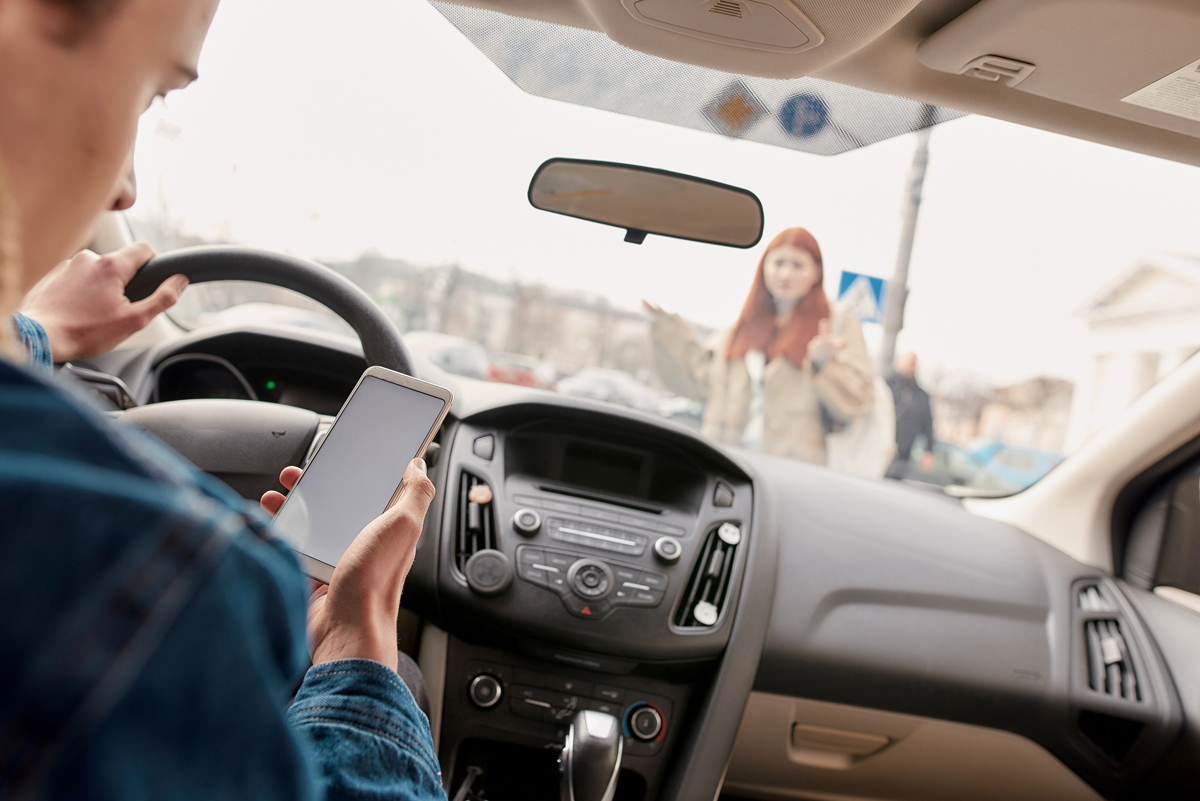
Struck by a Car While Walking in Fort Worth?
Before it ever reads your medical records, the driver’s insurance company has decided you stepped out, that you were not in a crosswalk, that you were looking at your phone.
Shifting blame onto the person on foot is the oldest move in the pedestrian claim playbook, and a Fort Worth pedestrian accident lawyer expects it from day one.
A two-ton vehicle against a human body is never a fair fight, yet the insurer will argue you caused your own broken bones, not because it is true but because it pays you less.
The way to answer it is with proof, gathered fast, before the video loops over and the witnesses scatter.
Texas law gives people on foot real rights at crosswalks and beyond them, and this page shows how to enforce those rights. The consultation is free, and you pay nothing unless we win.
Call (512) 254-4424 at any hour to talk through what happened.
Our Fort Worth Pedestrian Accident Lawyer

Goldberg & Loren Fights for Maximum Compensation


Pay Nothing, Unless We Win
Texas Injury Law at a Glance
| Deadline to file a lawsuit | Two years from the date of the injury. Tex. Civ. Prac. & Rem. Code § 16.003 |
| Fault rule | Modified comparative responsibility ("51% bar"): you recover only if you are 50% or less at fault, and your award is reduced by your share. §§ 33.001, 33.012 |
| Reporting the crash | Notify police immediately when there is injury, death, or a vehicle that cannot be driven away safely. Tex. Transp. Code § 550.026 |
Why the Insurer Will Try to Blame You
Blame shifting is a strategy, not an accident. The moment an adjuster can pin a slice of fault on you, the value of your claim starts to fall, and in Texas it can fall all the way to zero.
Our pedestrian injury lawyers answer the insurer’s pointed questions with evidence instead of guesses.
You have no duty to give the other driver’s insurer a recorded statement, and a few careless words can be twisted into an admission, so we handle those calls and let the physical proof speak first.
The Comparative Fault Trap Under the 51 Percent Rule
Texas uses modified comparative fault, and it carries a hard cliff. You can recover as long as your share of the blame stays at 50% or less, and your award shrinks by whatever percentage lands on you, but cross 51%, and you collect nothing.
On a $200,000 claim, 20% fault recovers $160,000 and 50% still recovers $100,000, while one point higher is worth nothing. The insurer does not need to prove you caused the whole crash, only to nudge your share past the halfway mark, so strong evidence keeps your percentage low and keeps the claim alive.
What Texas Right of Way Law Says About Crosswalks
Most people think a crosswalk has to be painted to count. It does not. Texas law protects pedestrians at intersections whether or not the lines are on the pavement, and right of way is the backbone of a pedestrian claim.
When a driver violates it, that violation becomes powerful evidence of negligence, and the insurer’s stepped-out story starts to fall apart under the weight of the statute.
Marked and Unmarked Crosswalks Under Section 552
Section 552 of the Texas Transportation Code sets the rules for people on foot.
Drivers must yield to a pedestrian lawfully in a crosswalk, and an unmarked crosswalk exists at most ordinary intersections even with no paint on the ground, so a pedestrian crossing there has the right of way and a driver who rolls a right turn without looking has likely broken that duty.
The statute cuts both ways, asking pedestrians to follow signals and avoid darting into traffic, so we use the parts of the law that fit your facts and prepare for the parts the insurer will raise.
The Driver Due Care Duty That Survives a Mid-Block Crossing
Even away from an intersection, a driver is not free to hit whoever is in the road. Section 552 requires every driver to use due care to avoid striking a pedestrian, to sound the horn when needed, and to take extra caution around anyone confused or in distress.
Insurers love to say a person crossing outside a crosswalk is automatically at fault, but that is not the law: the driver still had to pay attention and try to avoid the collision once you were visible, and a person walking across four lanes is in the road for several seconds an attentive driver would have used to stop.
Fair is fair, and the statute does place duties on pedestrians too. Outside a crosswalk, a person on foot generally must yield to vehicles, and crossing against a signal can shift some fault onto the pedestrian.
But shared duty rarely means the pedestrian loses, because the 50% rule can still leave a substantial recovery when strong evidence keeps your share low.
How We Beat the “They Darted Out” Defense
The darted out defense lives or dies on evidence, and most of that evidence has a short shelf life. Beating it means moving before the proof disappears. These are the pieces that tend to decide whether the defense holds up.
- Traffic and nearby business camera footage that captured the crossing and the vehicle’s speed.
- The driver’s cell phone records, which can show a call or text at the moment of impact.
- The vehicle’s event data recorder, which logs speed and braking in the seconds before the hit.
- Skid marks, the point of impact, and where your body and belongings came to rest.
- Independent witnesses and the timing of the walk signal you were following.
Gathered together and fast, those pieces reconstruct the crossing second by second, and a driver who claimed you appeared from nowhere often turns out to have been speeding or distracted.
Camera footage and vehicle data vanish first, so those come first: convenience-store, apartment-gate, doorbell, and dash footage often overwrites within days, and a quick preservation letter can be the difference between proof and a shrug.
When a data download shows the driver never touched the brakes, or the phone log shows an active text at impact, the stepped-out story collapses, and an accident reconstruction can convert a fault dispute into a math problem the insurer cannot win.
Where Pedestrians Get Hit Most Often in Tarrant County
Some streets punish people on foot more than others. Wide, fast arterials with long gaps between signals invite mid-block crossings, and drivers there carry speed that turns a survivable hit into a catastrophe.
Corridors like East Lancaster Avenue and Riverside Drive move a lot of traffic at speed with crosswalks far apart, and they carry heavy frontage road traffic near I-35W, where drivers exit at highway speed and scan for merging cars rather than for people.
Speed is the single biggest factor in whether a pedestrian survives, so we treat a speeding claim as central: it connects the driver’s choice directly to the harm.
Stockyards and Downtown Foot Traffic Near One-Way Streets
Downtown and the Stockyards flip the danger. Here the speeds are lower, but the foot traffic is dense, and one-way streets confuse drivers and visitors alike.
A turning driver watching for a gap in traffic can miss the person legally stepping off the curb, and crashes in these districts often involve drivers unfamiliar with the one-way grid, so the video from nearby businesses becomes some of the best evidence in the case.
Putting a Value on a Serious Pedestrian Injury
A pedestrian rarely walks away from a vehicle strike with minor bruises, and the losses run far larger than a first hospital bill suggests, which is why the number an adjuster floats early is usually far below the real cost.
Many seriously injured pedestrians in Tarrant County arrive at John Peter Smith Hospital, the region’s Level I trauma center, and the bills keep climbing through surgery, imaging, rehabilitation, and follow-up care, along with lost income.
Reduced earning power, ongoing pain, and the limits a permanent injury places on daily life all carry value under Texas law. Because most injury suits carry a two year deadline, we start building that record early while the evidence and treatment history are fresh.
Hit and Run and Fatal Pedestrian Crashes and the Families Left Behind
Some of the hardest cases involve a driver who fled or a loved one who did not survive, and the answer to whether recovery is possible is often yes; the path just runs through different coverage than most people expect.
When the at-fault driver cannot be found, your own uninsured motorist coverage can step in and pay for a hit-and-run, and many people carry that coverage without realizing it protects them as pedestrians, not just as drivers.
Police work, camera canvassing, and vehicle debris sometimes identify a fleeing driver after the fact, which opens that driver’s liability coverage too. When a crash turns fatal, Texas law lets certain family members bring a claim for their loss, and we handle those cases with the seriousness they deserve while shielding the family from the insurer.
Answer the Blame Game With a Fort Worth Pedestrian Accident Lawyer
If a vehicle hit you or someone you love while walking in Fort Worth, the insurer is already building its stepped-out story. You do not have to face that alone, and you should not give a recorded statement before you understand your rights. Our team holds decades of experience, and you pay nothing unless we win.
We will preserve the video, pull the driver’s records, and put Texas right-of-way law to work while you focus on healing. A real person answers 24 hours a day. Reach a Fort Worth pedestrian accident lawyer at (512) 254-4424, or tell us what happened through our contact page.
Frequently Asked Questions
Your own auto policy may still pay, even though you were walking. Texas insurers cannot issue an auto policy without including uninsured and underinsured motorist coverage, and it applies unless you rejected it in writing (Tex. Ins. Code § 1952.101). Many people carry it without knowing.
Pulling your declarations page is one of the first things we do when a driver is uninsured or never found.
Sometimes, but the path is narrow and short. A governmental unit can be liable when a traffic signal or warning device is absent, malfunctioning, or in bad condition. Liability attaches only if the agency fails to fix it within a reasonable time after notice (Tex. Civ. Prac. & Rem. Code § 101.060).
Formal written notice of your claim is due within six months, and a city charter can demand it sooner (§ 101.101).
The hospital often secures itself with a lien rather than waiting. If you were admitted within 72 hours of being struck, it can attach one to your claim (Tex. Prop. Code § 55.002), capped at half of whatever you recover (§ 55.004).
Ambulance providers cannot lien a claim in Tarrant County, since that right stops at counties of 800,000 people and this one holds about 2.2 million (U.S. Census Bureau).
Reporting a crash and filing a lawsuit are two very different deadlines, and the reporting one is far shorter. Under Texas law, if anyone is injured or killed, or a vehicle is too damaged to be driven away safely, the drivers involved must notify police immediately, by the quickest means available, not days later (Tex. Transp. Code § 550.026).
You also have to stop at the scene, give your name, address, and insurance information, and help anyone who is hurt (§§ 550.021–550.023). Leaving the scene of an injury crash is a serious crime in Texas, not a paperwork issue.
You may have heard that you have “ten days to file a crash report.” That ten-day deadline actually belongs to the investigating police officer, who must send the official crash report to TxDOT within ten days when a wreck causes injury, death, or at least $1,000 in property damage (§ 550.062).
Your job is to report the crash to police right away, then notify your own insurer promptly.
If your crash happened in Fort Worth, the Fort Worth Police Department handles it, and you can get your official crash report from the Fort Worth Police Records Unit at 1000 Calvert St., Fort Worth, TX 76107 (817-392-4160), or order it online through TxDOT.
If you are not sure what it says about fault, call us at (512) 254-4424 and we will walk you through it.
Legal Sources & References
The Texas laws described on this page are cited to the official statutes published by the Texas Legislature and were last reviewed on August 12, 2026.
- Statute of limitations (2 years), Tex. Civ. Prac. & Rem. Code § 16.003
- Comparative responsibility & reduction, Tex. Civ. Prac. & Rem. Code §§ 33.001, 33.012
- Duty to report a crash, Tex. Transp. Code §§ 550.021–550.026, 550.062
- Texas crash data, Texas Department of Transportation (TxDOT)