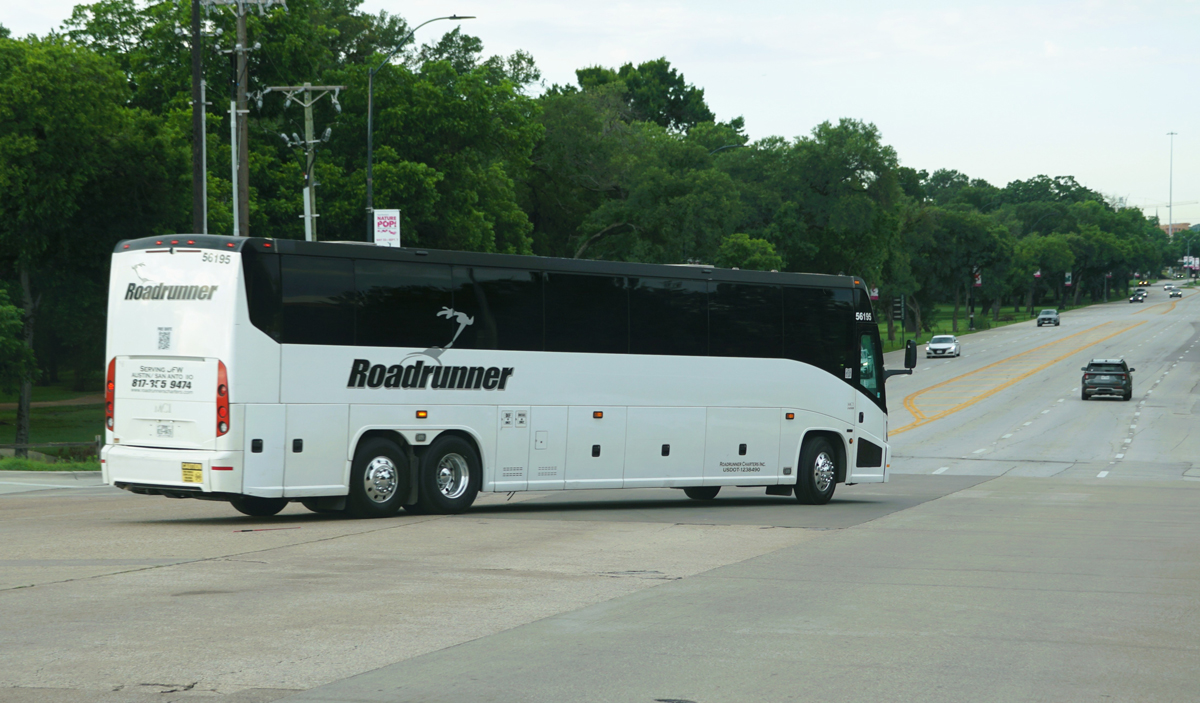
Were You Injured in a Fort Worth Bus Accident?
A Trinity Metro city bus plays by one rulebook, a Fort Worth ISD school bus plays by another, and a private charter coach plays by a third.
If you were hurt on any of them, a Fort Worth bus accident lawyer can tell you which set of rules controls your claim before a deadline quietly closes the door.
That is the part injured riders miss. A crash with a government bus can carry a notice deadline as short as six months, nothing like the two years you usually get against a private company, and missing it can make a strong claim vanish on a technicality that had nothing to do with your injuries.
The first job is simple: figure out who was behind the wheel, who owned the bus, and which deadline applies. The consultation is free, and you pay nothing unless we win. Call (512) 254-4424 any hour, any day.
Our Fort Worth Bus Accident Lawyer

Goldberg & Loren Fights for Maximum Compensation


Pay Nothing, Unless We Win
Texas Injury Law at a Glance
| Deadline to file a lawsuit | Two years from the date of the injury. Tex. Civ. Prac. & Rem. Code § 16.003 |
| Fault rule | Modified comparative responsibility ("51% bar"): you recover only if you are 50% or less at fault, and your award is reduced by your share. §§ 33.001, 33.012 |
| Claims against a government bus (transit/school district) | Written notice within six months (or less by charter), and damages capped by the type of governmental unit. §§ 101.101, 101.023 |
| Reporting the crash | Notify police immediately when there is injury, death, or a vehicle that cannot be driven away safely. Tex. Transp. Code § 550.026 |
Which Bus Hit You Decides How Your Claim Is Filed
Buses share the same roads but answer to very different owners. On any given morning in Fort Worth, you might ride next to a public transit bus, a yellow school bus, a hotel shuttle, and a charter coach, each with its own insurance, rules, and deadline.
Our bus injury attorneys start every bus case by sorting out which category you are dealing with, because the wrong assumption can cost a claim:
- Trinity Metro city buses and TEXRail, run by Fort Worth’s public transit authority, a government entity.
- Fort Worth ISD and other school district buses that move students across Tarrant County.
- Private charter and tour coaches hired for trips, weddings, and game day runs.
- Hotel, DFW Airport, and university shuttles operated by private companies.
Some of those buses belong to the government, and some belong to private businesses, and that single split changes your deadline, your paperwork, and the ceiling on what you can recover.
It also changes who we investigate: a government claim means public records requests and a strict notice letter, while a private carrier claim means chasing corporate maintenance files and driver records before the company buries them.
Trinity Metro Buses, TEXRail, and the Government Rulebook
Trinity Metro is Fort Worth’s public transit authority, running the city buses, the TEXRail line from downtown to DFW Airport, and part of the Trinity Railway Express with Dallas. Because it is a government body, a claim against it does not work like a claim against a careless private driver.
Government defendants get special protections: you have to give formal notice fast, your damages face statutory caps, and the agency has legal defenses a private company does not.
A rider who treats a Trinity Metro claim like an ordinary car wreck can burn the notice window without knowing it existed, so the case needs someone who knows the government rules and moves before the deadline.
School District Buses and Private Charter Coaches
School buses sit in a strange middle ground.
The district is a government entity, so the tight notice rules and caps often apply, yet the driver may be a district employee whose conduct opens other doors, so when a Fort Worth ISD route ends in an emergency room, the investigation has to move quickly while cameras, routes, and maintenance logs are still fresh.
Private charter and tour coaches flip the analysis entirely: a company that sells seats to the public owes a heightened duty of care and usually carries far more insurance.
The coach may be owned by one company, operated by another, and maintained by a third, so sorting out those relationships early keeps any responsible party from slipping out of the case.
The Government Claim Clock That Starts on Day One
When a government bus is involved, the calendar becomes your biggest enemy. The Texas Tort Claims Act is the law that lets you sue a public entity at all, and its most dangerous string is the notice deadline, which a Fort Worth bus accident attorney tracks from the first phone call.
Send notice late, and the strongest case in the world can be dismissed before a jury ever hears a word about your injuries, because courts enforce this rule strictly and good faith is not an excuse for missing it.
The Texas Tort Claims Act Notice Deadline
The Act allows units of government up to six months to receive formal notice of a claim, and many Texas cities shorten that window even further through their own charters.
Six months sounds generous when you are lying in a hospital bed, then it evaporates while you focus on healing, so the safest move is to treat the deadline as much shorter than you think. Notice is not a lawsuit; it is a formal document that puts the agency on written warning, and it has to reach the right office.
What a Formal Notice Must Contain and When It Is Due
A valid notice describes the damage or injury, names the time and place of the incident, and lays out how it happened. Leave a piece out and the agency can argue the notice was defective, an argument that alone has ended real claims that deserved to be paid.
Timing matters as much as content: the document has to land within the deadline and go to the correct government office, because a letter sent to the wrong department can be treated as no notice at all. We prepare and serve that notice so a paperwork error never becomes the reason a family walks away empty-handed.
How Several Injured Riders Share One Capped Fund
The Tort Claims Act caps what a government body pays. For a unit of local government such as a transit authority or school district, the limit is $100,000 per person and $300,000 per occurrence for bodily injury or death, plus $100,000 for property damage.
Picture fifteen riders hurt in one wreck sharing a single $300,000 ceiling: there may not be enough to make everyone whole, so the people who document their injuries early and file first are in a far stronger position than those who wait.
Private Bus Companies Owe Passengers a Higher Duty
Private bus companies do not hide behind government caps, and they carry a heavier legal duty on top of it.
Texas treats a company that transports the public as a common carrier, which means it must use a high degree of care to keep passengers safe, a standard stricter than the ordinary care a regular driver owes, and a private carrier claim generally must be filed within two years.
A charter operator that skips maintenance, overworks a driver, or ignores a known hazard can be held to that higher standard in front of a jury, and where a government claim runs into a cap, a private carrier’s commercial coverage is often large enough for a catastrophic injury.
Charter, Tour, and Airport Shuttle Operators
Charter and tour companies run game day trips, weddings, and corporate outings all over Tarrant County, and airport shuttles move travelers to DFW around the clock. When these operators cut corners, the common carrier duty gives you a strong footing, with insurance limits usually high enough to cover a serious injury.
The catch is speed: corporate carriers hire investigators fast and put their coaches right back into service, so we move to preserve the maintenance record, the driver’s hours, the trip manifest, and any onboard video immediately.
Injuries That Happen With No Collision at All
Not every bus injury involves a crash. A hard brake, a lurch away from the curb, or a driver pulling out before you reach a seat can throw a standing passenger to the floor, and those cases surprise riders who assume they need a dramatic collision to have a claim.
These claims turn on whether the driver operated the bus in a way that a careful professional would not.
Sudden Stops, Standing Riders, and Falls in the Aisle
Standing riders take the worst of a sudden stop. Older passengers and anyone holding groceries or a child have almost no way to catch themselves when a bus jerks, and a fractured wrist, a hip injury, or a head strike on a metal rail can follow from a single careless maneuver.
Fault comes down to whether the driver gave riders a reasonable chance to be secure. Onboard cameras, the driver’s route log, and rider accounts tell that story, and we move to collect them before anything gets overwritten.
Why Video From the Bus Disappears on a Schedule
Most transit and charter buses record their own footage on a loop, sometimes within days or a few short weeks, so the clip that shows the driver slamming the brakes can be gone before you finish your first doctor visit. A prompt preservation demand freezes that footage in place, and we send one immediately, naming the vehicle and the time window.
Once the footage is preserved, it often ends the argument, because a carrier that hoped to blame the passenger has a much harder time when the video shows exactly what the driver did.
What a Serious Fort Worth Bus Injury Claim Is Worth
Value depends on the injury, the coverage, and which rulebook applies. A private charter claim with high limits looks very different from a capped government claim shared among many riders, and an honest case assessment starts by naming those boundaries instead of promising a number nobody can guarantee.
What a claim can account for reaches well past the first hospital bill.
Medical Care, Lost Work, and Long-Term Needs
A serious bus injury drives medical costs, from the ambulance and emergency care to surgery, imaging, and months of therapy. Time away from work stacks on top, and a lasting injury can shrink your earning power for years.
A back or joint injury can require future procedures, and an older rider may need help at home that a family did not budget for, so we work with medical providers to map out that future care as part of the demand.
Pain, limited mobility, and the daily toll of a long recovery matter too, and we document the full arc of the injury so the demand reflects your life.
Beat the Notice Deadline With a Fort Worth Bus Accident Lawyer
If a bus hurt you or someone you love in Fort Worth, the safest thing you can do today is find out which deadline is already running, because a government claim can demand notice within months and that window does not pause while you recover.
Our firm answers with decades of experience, and there is no fee unless we recover for you: we will identify the right defendant, protect the notice deadline, and demand the video and records before they cycle out of existence.
You do not need to know whether Trinity Metro, a school district, or a charter company is responsible before you call. Working that out is our job, and a real person answers 24 hours a day. Reach a Fort Worth bus accident lawyer at (512) 254-4424, or send us the details through our contact page.
Frequently Asked Questions
Yes, and the bus itself is the reason. The Texas Tort Claims Act does not reach a school district at all, except as to motor vehicles (Tex. Civ. Prac. & Rem. Code § 101.051). A bus is a motor vehicle, so a crash claim survives where a playground or classroom claim would be barred. Who employed the driver still matters.
The Act’s definition of employee leaves out an independent contractor and anyone whose work the district has no legal right to control (§ 101.001).
Far more than a car, and the seat count sets the floor. A for-hire passenger carrier operating across state lines must hold at least $5 million in coverage for any vehicle seating 16 or more people, counting the driver. A smaller shuttle seating 15 or fewer must carry $1.5 million (49 CFR 387.33T).
Those are floors rather than ceilings, which is why naming a private operator can matter more than anything else in a capped government claim.
Usually your own coverage first, and the recovery settles up at the end. A Texas hospital that admitted you within 72 hours of the crash can attach a lien to your claim (Tex. Prop. Code § 55.002). That lien is capped at half of everything you collect (§ 55.004). One rule works in your favor here.
Ambulance providers may only file these liens in counties of 800,000 people or fewer, and Tarrant County has about 2.2 million (U.S. Census Bureau).
Longer than most riders expect, and government claims sit at the slow end. Texas courts disposed of 386,193 civil cases in fiscal year 2024, and 96,182 of them had been pending more than 18 months (Texas Office of Court Administration). A bus case adds records requests, a notice letter, and often a group of injured riders.
Settling early usually means settling short.
Not both, and the choice cannot be undone. Filing suit against a governmental unit immediately and forever bars any recovery from its individual employees over the same crash (Tex. Civ. Prac. & Rem. Code § 101.106). Suing only the driver for on-the-job conduct is treated as a suit against the agency anyway.
One further limit is worth knowing early: the Act does not authorize exemplary damages against a governmental unit (§ 101.024).
Legal Sources & References
The Texas laws described on this page are cited to the official statutes published by the Texas Legislature and were last reviewed on August 15, 2026.
- Statute of limitations (2 years), Tex. Civ. Prac. & Rem. Code § 16.003
- Comparative responsibility & reduction, Tex. Civ. Prac. & Rem. Code §§ 33.001, 33.012
- Texas Tort Claims Act, Tex. Civ. Prac. & Rem. Code §§ 101.021–101.023, 101.101
- Duty to report a crash, Tex. Transp. Code §§ 550.021–550.026, 550.062
- Texas crash data, Texas Department of Transportation (TxDOT)