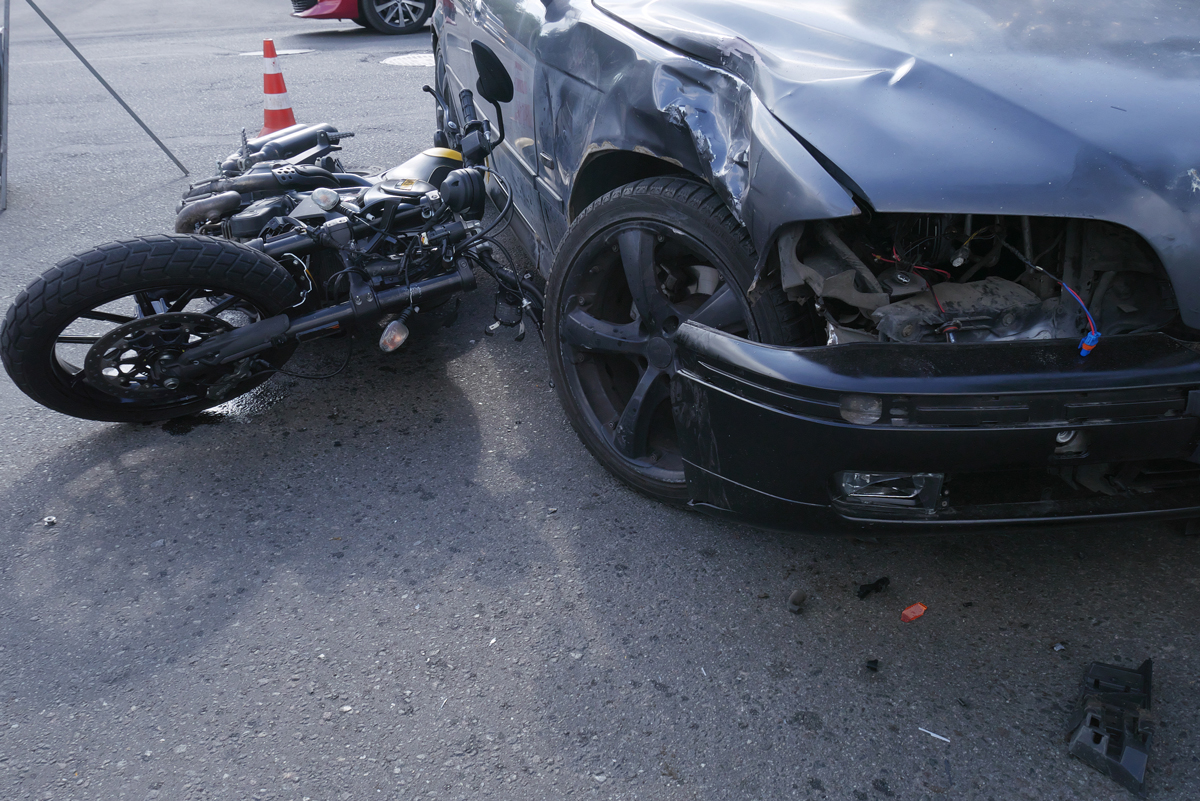
Down on Your Bike in Fort Worth?
The driver at the intersection looked right at you and turned anyway. That single moment, a left turn across your lane on a green light, is how most Fort Worth motorcycle crashes actually happen. It is rarely the reckless rider the insurer wants you to picture.
A Fort Worth motorcycle accident lawyer spends much of the early work correcting that first false story, because the version an adjuster writes down in the first 48 hours tends to follow your claim all the way to settlement.
You have probably heard the false story too. Someone told you that if you were not wearing a helmet, or if the helmet did not save you from a concussion, you have no case. That is not how Texas law works, and an adjuster who says otherwise is counting on you believing it.
Your right to recover after a crash turns on who caused the wreck, not on the gear you had on when another driver pulled into your path.
This page walks through the specific problems a rider faces in Tarrant County: how the helmet law really reads, how to beat the came-out-of-nowhere defense, which roads produce the hardest crashes, and the full list of losses you are allowed to claim.
Read it before you give a recorded statement or accept a fast check, because the choices you make this week shape what your case is worth months from now.
Hurt and need help? Call Goldberg & Loren at (512) 254-4424 for a free consultation.
Our Fort Worth Motorcycle Accident Lawyer

Goldberg & Loren Fights for Maximum Compensation


Pay Nothing, Unless We Win
Texas Injury Law at a Glance
| Deadline to file a lawsuit | Two years from the date of the injury. Tex. Civ. Prac. & Rem. Code § 16.003 |
| Fault rule | Modified comparative responsibility ("51% bar"): you recover only if you are 50% or less at fault, and your award is reduced by your share. §§ 33.001, 33.012 |
| Reporting the crash | Notify police immediately when there is injury, death, or a vehicle that cannot be driven away safely. Tex. Transp. Code § 550.026 |
The Helmet Law Myth We Hear Every Week
Ask any rider what worries them most about a claim, and many say the same thing. They were not wearing a helmet, or they were, and it cracked, and now they assume the insurance company holds all the cards. The legal team at our law firm, hears this fear almost every week from injured riders across Fort Worth, and it rests on a misreading of the law.
Fault decides your claim, while a helmet decides whether you walk away from a survivable crash, a different question entirely.
Texas does not require every rider to wear a helmet, and choosing to ride legally without one is not proof that you did anything wrong. When a driver turns left across your lane on Camp Bowie Boulevard, the helmet on your head or missing from it did not cause that driver to violate your right of way.
The law separates the cause of the crash from the severity of the injury.
The problem is that adjusters do not always play it straight. They know a jury might carry an unfair bias against motorcyclists, and they raise helmet questions early to build a story about a careless rider who brought this on himself. Once you understand what the statute really says, you take that tool away.
What Texas Actually Requires Under Section 661.003
Section 661.003 of the Texas Transportation Code is short and specific. Riders and passengers must wear approved protective headgear, with one large exception.
If you are at least 21 years old and you either carry a health insurance plan that covers motorcycle collision injuries or you completed an approved motorcycle operator training course, you may legally ride without a helmet. An officer cannot even stop you for the sole purpose of checking whether you meet that exception.
That last detail matters more than most riders realize. Because the choice to go without a helmet can be fully legal, it cannot be used to paint you as reckless. The statute treats a helmet-free ride by a qualifying adult as a lawful choice, and that is not negligence.
When an insurance company suggests otherwise, it is arguing against the plain words of the code.
How Insurers Misuse Your Helmet Choice to Shrink a Head Injury Claim
Even when they cannot deny your claim outright, adjusters look for ways to shrink it. On a head injury claim, the favorite move is to argue that a helmet would have prevented or reduced your injury, so the driver who hit you should pay less.
This is a comparative fault argument dressed up as common sense, and it can quietly cut a serious settlement when no one pushes back.
The response starts with the law and ends with the medicine. Riding legally without a helmet is not evidence of fault, and Texas does not let an insurer treat a lawful choice as negligence to reduce what it owes.
On top of that, the medical proof often shows the injury pattern had nothing to do with head protection, or that a helmet would not have changed the outcome at those forces.
Beating the They Came Out of Nowhere Defense
I never saw the motorcycle. That sentence is the entire defense in a huge share of car-versus-motorcycle crashes, and drivers reach for it because it sounds honest. Left unchallenged, it can convince an adjuster that the crash was just one of those things nobody could prevent.
A careful claim treats that sentence as a starting point, not a conclusion. The real question is not whether the driver saw you but whether the driver should have. Texas drivers owe a duty to look for everyone lawfully using the road, motorcycles included, and a failure to look is not the same as an inability to see.
Left Turns Across Your Lane and the Failure to Yield
The single most common way a car hits a motorcycle is the left turn. A driver waiting to turn left misjudges your speed or simply does not register you, then turns directly across your lane as you approach the intersection.
You have the right of way, the driver has a duty to yield, and the impact happens in the space where you had every legal reason to be. The same failure-to-yield pattern shows up when drivers pull out of parking lots and side streets without checking for a bike.
On West 7th Street, a driver coming the other way turns left toward a restaurant lot and cuts across a rider’s path, then repeats the classic line about not seeing the bike.
Because the turning driver almost always carries the legal duty to yield to oncoming traffic, this looks like a strong liability case, which is why insurers fight so hard to muddy who had the green and who was speeding.
Conspicuity Evidence That Proves the Driver Had Time to See You
The answer is conspicuity evidence, the collection of facts showing you were visible and the driver had a clear line of sight. It turns the vague did-not-see-me claim into a measurable question about sightlines, distance, and reaction time.
Several pieces build that picture. The angle of the intersection and any obstructions tell you what the driver could see from the turn lane, while your headlight, your position in the lane, and the color of your gear speak to how visible you were.
Dashcam footage from your bike or a nearby vehicle can settle the timing outright, and so can a doorbell or business security camera near the corner. A Fort Worth motorcycle accident lawyer gathers this material fast, because storefront video often records over itself within days.
Reconstruction adds the final layer. An expert can use skid marks, crush damage, and the resting positions of both vehicles to calculate speed and confirm that a reasonably attentive driver had enough time to yield. When the numbers show the driver had several seconds of clear view and still turned, the did-not-see-me story collapses.
Where the Worst Crashes Happen in Tarrant County
Some roads around Fort Worth turn a small mistake into a catastrophic crash.
High-speed loops, constant merging, and long stretches at full highway speed leave a rider almost no margin when a driver changes lanes without looking, and the location of your wreck often shapes both the severity of your injuries and the evidence available to prove your case.
Location also changes who might be responsible. A crash caused by a poorly maintained road surface or a dangerous work zone can bring in a contractor or a government entity, each with its own rules and deadlines, so sorting out every party who shares the blame is part of building a claim that covers what you truly lost.
Loop 820, US-287, and the Ride Out to the Hill Country
Loop 820 rings the city and carries some of the heaviest, fastest traffic a rider will face, with constant merging where the north and east legs meet other highways.
US-287 moves riders toward Wichita Falls and back at high speed, and US-377 and SH-199, the old Jacksboro Highway, mix commercial traffic with riders heading out of town, each with its own trouble spots where speed and lane changes put motorcycles at the greatest risk.
Weekend rides carry a different risk. Many Fort Worth riders point their bikes southwest toward the Hill Country for the curves and the scenery, and those two-lane roads bring blind crests, gravel washouts, and drivers who cross the center line.
A crash 90 minutes outside Tarrant County raises practical questions about where you get treated and which county’s court hears the case.
When a Road Defect or Loose Gravel Makes a Government Entity Liable
Not every motorcycle crash traces back to another driver. A deep pothole, a broken edge of pavement, or a patch of loose gravel left after roadwork can drop a rider in an instant, and when a public road is the cause, the government entity responsible for maintaining it may be liable.
That opens a very different kind of claim with a much shorter deadline.
Suing a city, a county, or the state is nothing like filing against a private driver. The Texas Tort Claims Act limits when and how a government entity can be held responsible, and it requires formal written notice of your claim within a strict window.
That deadline can run as short as six months from the date of the crash, far shorter than the general deadline for an ordinary injury case, and missing it can end an otherwise strong claim before it starts.
Road-defect cases also depend on evidence that vanishes. The pothole gets patched, the gravel gets swept, and the very hazard that hurt you is gone within days of a report. Photographs, maintenance records, and prior complaints about the same stretch of road become the strongest evidence you have, and someone has to request and preserve them quickly.
Injuries and Losses We Document for Riders
A rider has no steel cage, no airbags, and no crumple zone. When a car and a motorcycle collide, the rider absorbs the force, and the injuries are often severe enough that riders across the region are taken straight to John Peter Smith Hospital, known locally as JPS, the area’s Level I trauma center.
The medical bills start climbing from the ambulance forward and rarely stop at the first hospital stay. Documenting every loss is the part injured riders most often get wrong, because the losses riders forget to claim are frequently the largest ones.
- Replacement of the motorcycle and the riding gear destroyed in the crash
- Future surgeries and the months of physical therapy that follow them
- Lost wages now and reduced earning capacity if you cannot return to the same work
- Permanent scarring and disfigurement from road rash and burns
- Out-of-pocket travel to and from every medical appointment
How much of that total you actually recover depends on Texas fault rules. Under the modified comparative fault system in Chapter 33 of the Civil Practice and Remedies Code, your recovery drops by your share of the blame, and if you are found 51% or more at fault you recover nothing.
This is exactly why the insurance company works so hard to pin part of the blame on you, and why documenting both your losses and the other driver’s fault protects the money you are owed.
Road Rash, Fractures, and the Surgeries That Follow for Years
Road rash sounds minor until you understand what it really is. Sliding across pavement can grind away skin down to muscle and bone, and deep road rash often needs surgical scrubbing and skin grafts to heal, leaving permanent scars.
Riders also suffer broken wrists, arms, and legs when they brace for impact or when the bike lands on top of them.
The hardest injuries keep costing money for years. A shattered joint or a badly broken leg can require a first surgery to set it, later surgeries to remove or replace hardware, and repeat operations when the original repair fails, with physical therapy running alongside for a year or more.
A settlement that only covers today’s bills leaves you paying for tomorrow’s, which is why a claim has to account for the full arc of your recovery before you sign anything.
Fort Worth Motorcycle Accident Lawyers
Motorcycle cases reward the people who move first. Skid marks fade, storefront cameras record over their footage, debris gets swept from the road, and witnesses forget what they saw.
Texas also gives you a hard two-year deadline from the date of the crash to file most injury lawsuits, and any claim against a government entity for a road defect can demand written notice far sooner. The longer you wait, the more the other side’s did-not-see-me story hardens into the official record.
You do not have to sort this out alone while you are trying to heal. A free consultation with our team costs you nothing and puts a clear plan in front of you, including what your claim may be worth and what to do before you talk to the insurance company again.
Bring whatever you have: the crash report, photos of your bike and your injuries, and the name of the driver’s insurer.
Experience matters when the insurance company is betting you will settle for less than your case is worth. Our legal team carries decades of experience, riders pay nothing unless we win, and we treat a motorcycle claim as seriously as any other severe injury case, not as the fault of the rider.
Call (512) 254-4424 today, or reach us through our contact page to start your free consultation and protect your claim while the evidence is still fresh.
Frequently Asked Questions
Then the policy runs out fast, and your own coverage becomes the case. Texas requires just $30,000 per injured person, $60,000 per crash, and $25,000 for property damage (Tex. Transp. Code § 601.072). One surgery can pass $30,000 before rehabilitation starts.
Insurers must include uninsured and underinsured motorist coverage unless you rejected it in writing, so check your declarations page early (Tex. Ins. Code § 1952.101)
Usually your own coverage first, and the recovery settles up at the end. A Texas hospital that admitted you within 72 hours of the crash can attach a lien to your claim (Tex. Prop. Code § 55.002), and that lien is capped at half of everything you collect (§ 55.004).
Ambulance providers cannot file one here at all, because that lien is limited to counties of 800,000 people or fewer and Tarrant County has about 2.2 million (U.S. Census Bureau).
Very few do. Texas courts disposed of 57,842 motor vehicle injury cases in fiscal year 2024, and only 428 ended in a jury verdict (Texas Office of Court Administration). Nearly every rider’s case is decided in negotiation instead. What moves an adjuster is the evidence file, which is why the first two weeks matter more than the courthouse.
Reporting a crash and filing a lawsuit are two very different deadlines, and the reporting one is far shorter. Under Texas law, if anyone is injured or killed, or a vehicle is too damaged to be driven away safely, the drivers involved must notify police immediately, by the quickest means available, not days later (Tex. Transp. Code § 550.026).
You also have to stop at the scene, give your name, address, and insurance information, and help anyone who is hurt (§§ 550.021–550.023). Leaving the scene of an injury crash is a serious crime in Texas, not a paperwork issue.
You may have heard that you have “ten days to file a crash report.” That ten-day deadline actually belongs to the investigating police officer, who must send the official crash report to the Texas Department of Transportation within ten days when a wreck causes injury, death, or at least $1,000 in property damage (§ 550.062).
The separate report drivers once mailed in themselves was eliminated years ago. Your job is to report the crash to police right away, then notify your own insurance company promptly, as your policy requires.
If your crash happened in Fort Worth, the Fort Worth Police Department handles it, and you can get a copy of your official crash report from the Fort Worth Police Records Unit at 1000 Calvert St., Fort Worth, TX 76107 (817-392-4160), or order it online through the Texas Department of Transportation.
If you are not sure how to get your report or what it says about fault, call us at (512) 254-4424 and we will walk you through it.
Legal Sources & References
The Texas laws described on this page are cited to the official statutes published by the Texas Legislature and were last reviewed on August 15, 2026.
- Statute of limitations (2 years), Tex. Civ. Prac. & Rem. Code § 16.003
- Comparative responsibility & reduction, Tex. Civ. Prac. & Rem. Code §§ 33.001, 33.012
- Duty to report a crash, Tex. Transp. Code §§ 550.021–550.026, 550.062
- Texas crash data, Texas Department of Transportation (TxDOT)