California Wrongful Death Law: Inheritance and Eligible Family Members
Dealing with a wrongful death in California can be overwhelming, especially when trying to navigate inheritance rights and how compensation is awarded after such a tragic loss.
The confusion around legal definitions, competing claims, and the complexities of California law can make justice feel out of reach.
This guide clarifies who qualifies as an heir, what damages may be available, and how the legal process truly unfolds for grieving families seeking answers.
Defining Wrongful Death and Inheritance Rights
Wrongful death represents a legal pathway for families seeking justice when a loved one dies due to another party’s negligence or intentional misconduct.
In California, these claims are governed by specific statutes that outline who can pursue compensation and what damages may be recovered. Wrongful death claims provide a critical mechanism for survivors to address both economic and emotional losses resulting from an unexpected death.
Under California law, several categories of individuals have legal standing to file a wrongful death lawsuit. Eligible claimants typically include the deceased person’s immediate family members such as a surviving spouse, domestic partner, children, and in some cases, parents or siblings who were financially dependent on the decedent.
The California Code of Civil Procedure (CCP) 377.60 specifically defines these inheritance and compensation rights, ensuring that those most impacted by the loss can seek legal recourse.
The damages recoverable in a wrongful death claim are comprehensive, addressing both tangible financial losses and intangible emotional harm. Families may seek compensation for lost future earnings, medical expenses incurred before death, funeral and burial costs, loss of companionship, and potential emotional distress.
While no monetary award can truly replace a lost loved one, these legal provisions aim to provide financial stability and a sense of justice for grieving families navigating an incredibly challenging time.
Categories of Heirs Under California Law
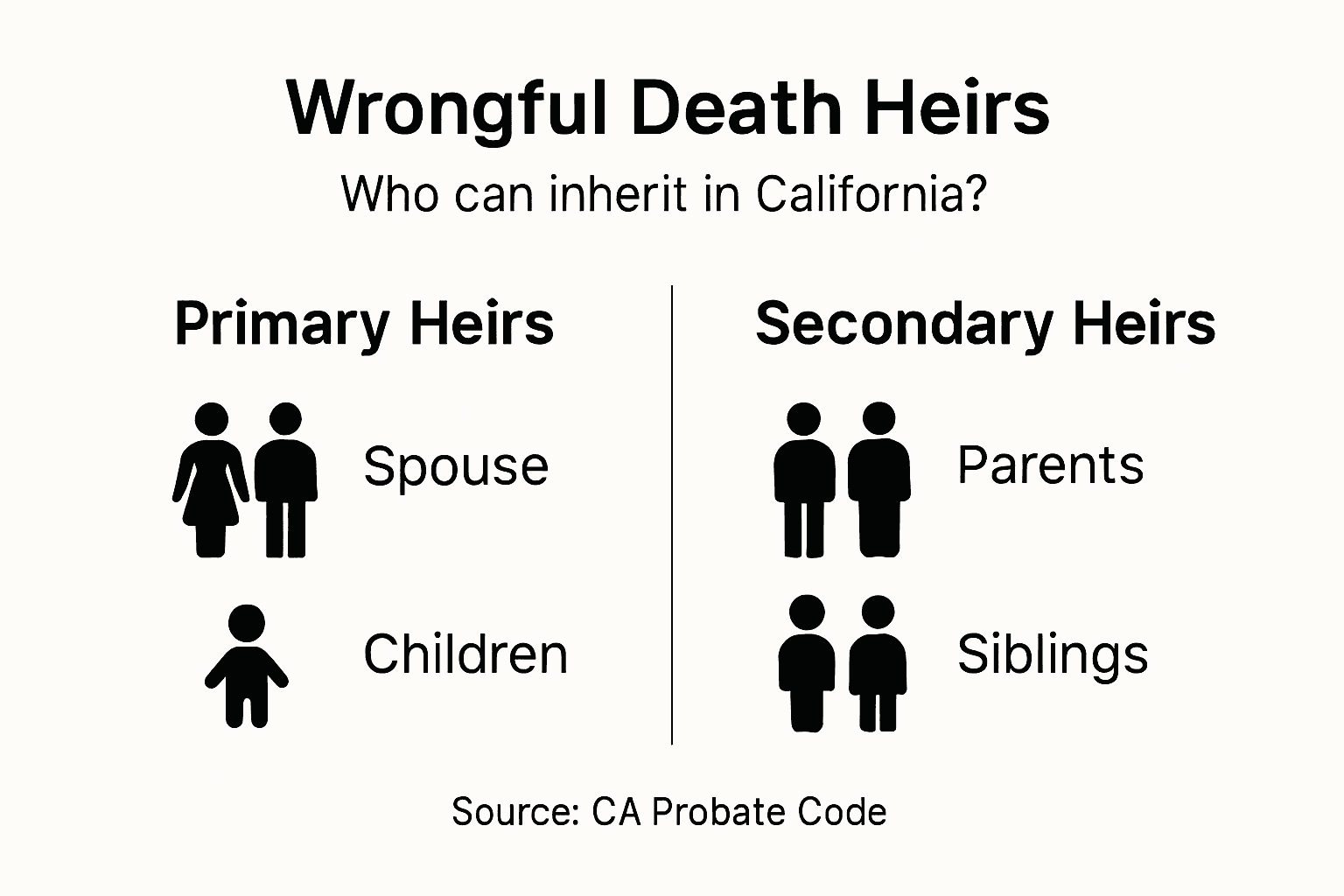
California law provides a structured hierarchy for determining who can pursue wrongful death claims after a loved one’s death. This legal framework prioritizes immediate family members and recognizes the complex nature of familial relationships. The primary categories of potential heirs include the surviving spouse, domestic partner, and biological or legally adopted children.
When no immediate family exists, the inheritance rights extend to secondary beneficiaries. Secondary claimants may include parents, siblings, stepchildren, and individuals who were financially dependent on the deceased. The law acknowledges that family structures are diverse and not always traditional.
For instance, a putative spouse (someone who believed they were legally married) or a stepchild who was financially supported by the decedent might have legitimate claims to compensation.
The personal representative of the deceased’s estate plays a crucial role in managing and filing these claims. This individual is responsible for gathering evidence, filing legal documentation, and potentially distributing any recovered damages among eligible heirs.
The complexity of these claims underscores the importance of understanding the nuanced hierarchy of inheritance rights under California law, which aims to provide fair compensation to those most significantly impacted by the loss.
Pro tip: Gather comprehensive documentation about your relationship to the deceased, including marriage certificates, financial records, and proof of dependency to strengthen your potential wrongful death claim.
Here’s a summary of key claimant types and their possible compensation in California wrongful death cases:
| Claimant Category | Example Relationship | Typical Compensation Types |
|---|---|---|
| Immediate family | Spouse, child | Economic loss, emotional damages |
| Secondary beneficiary | Parent, sibling | Limited financial compensation |
| Dependent individual | Stepchild, putative spouse | Financial support, partial damages |
| Estate representative | Appointed by probate | Distributes recovered damages |
California’s Order of Inheritance and Succession
California’s inheritance laws create a precise hierarchy for distributing assets when someone dies without a will, particularly in wrongful death claim scenarios. The legal system prioritizes immediate family members, establishing a clear order of succession that ensures fair distribution of the deceased’s estate and potential compensation.
The primary inheritance pathway begins with the surviving spouse or domestic partner, who typically receives all community property and a substantial portion of separate property. If children are present, they share the remaining separate property. When no spouse or children exist, the inheritance rights shift to the decedent’s parents, and subsequently to siblings.
This systematic approach ensures that close family members with the strongest emotional and financial connections are protected first.
Unique circumstances can complicate inheritance rights, particularly for blended families or those with complex relationships. The law recognizes various familial configurations, including putative spouses, financially dependent relatives, and legally adopted children.
Each category has specific criteria for inheritance, reflecting California’s nuanced approach to understanding family dynamics and economic dependencies in wrongful death scenarios.
Legal Process for Wrongful Death Claims
Filing a wrongful death claim in California requires navigating a complex legal landscape with strict procedural requirements. The process begins with establishing that the death resulted from another party’s negligence or intentional misconduct, typically within a critical two-year statutory limitation period.
Claimants must meticulously gather evidence, including:
- medical records,
- expert testimony,
- and documentation of financial and emotional damages.
The legal proceedings typically involve several key stages. Initially, the personal representative of the deceased’s estate files the formal claim, which may proceed through negotiation, mediation, or direct litigation.
Proving negligence requires demonstrating a clear causal link between the defendant’s actions and the fatal incident. This often involves complex investigations, expert witness testimonies, and comprehensive documentation of the economic and non-economic impacts on the surviving family members.
California courts carefully evaluate wrongful death claims, considering multiple factors such as the deceased’s potential future earnings, the emotional impact on survivors, and the specific circumstances surrounding the death.
The legal system recognizes that each case is unique, requiring a nuanced approach to determining appropriate compensation. Families must provide substantial evidence of financial dependency, emotional loss, and the direct consequences of their loved one’s untimely death.
Pro tip: Preserve all potential evidence immediately after the incident and avoid discussing the case publicly to protect the integrity of your potential legal claim.
Potential Challenges to Wrongful Death Inheritance
Wrongful death inheritance claims in California can encounter complex legal disputes that challenge even the most straightforward family situations. The legal landscape is fraught with potential obstacles that can significantly complicate the inheritance process, requiring careful navigation and comprehensive documentation.
One of the most significant challenges emerges from competing claims among potential heirs. Family members may dispute their eligibility, particularly in cases involving blended families, estranged relationships, or complex financial dependencies.
Issues such as proving financial support, establishing legal relationships, and demonstrating the extent of emotional and economic loss can create substantial legal barriers.
Some claimants might face challenges related to the timing of their claims, as California enforces a strict two-year statute of limitations for filing wrongful death lawsuits.
Additional complications can arise from intersecting legal domains, including:
- estate laws,
- probate proceedings,
- and potential creditor claims.
The court must carefully evaluate multiple factors such as the nature of familial relationships, financial dependencies, and the specific circumstances surrounding the death.
Competing claims from distant relatives, former spouses, or individuals claiming financial dependency can further complicate the inheritance distribution process, often requiring extensive legal proceedings to resolve.
Secure Justice and Your Inheritance Rights After a Wrongful Death
Losing a loved one due to someone else’s negligence leaves deep emotional wounds and complex legal challenges. Understanding who inherits after a wrongful death in California can be overwhelming when facing disputes over eligibility, financial dependency, and strict timelines.
Key issues like proving relationships, navigating the order of inheritance, and meeting procedural deadlines demand expert guidance to protect your rights and pursue fair compensation.
At Goldberg & Loren, we specialize in wrongful death cases with over 120 years of combined experience fighting for families in California and nationwide. We know how critical it is to act quickly and gather strong evidence to ensure your inheritance rights are preserved. Don’t face eligibility disputes or legal complexities alone.
Take the first step now by calling Goldberg & Loren at (661) 669-8224 to schedule your free wrongful death inheritance consultation with skilled wrongful death attorneys who understand the nuances of California inheritance law and are committed to maximizing your recovery.
Frequently Asked Questions
Who is eligible to file a wrongful death claim in California?
Under California law, eligible claimants typically include the deceased person’s immediate family members such as a surviving spouse, domestic partner, children, and in some cases, parents or siblings who were financially dependent on the decedent.
What types of damages can be recovered in a wrongful death claim?
Damages in a wrongful death claim can include compensation for:
- lost future earnings,
- medical expenses incurred before death,
- funeral and burial costs,
- loss of companionship,
- and emotional distress.
What happens if there are competing claims among potential heirs?
Competing claims can arise when family members dispute their eligibility, which may lead to legal challenges. The court will need to evaluate the evidence presented to determine who is entitled to compensation.
How does California’s inheritance law affect wrongful death claims?
California’s inheritance laws create a hierarchy of heirs, prioritizing immediate family members for the distribution of assets. This hierarchy influences who can file wrongful death claims and how damages are distributed.