Pregnancy Discrimination in Fresno: Your Rights and Employer’s Duties
Facing unfair treatment at work simply because you are expecting can leave you feeling stressed and uncertain about your future. Pregnancy discrimination is illegal under both California and federal law, yet many women in Fresno still encounter barriers to equal treatment and reasonable accommodations.
By learning about your protected employment rights and understanding what constitutes discrimination, you can take important steps to protect yourself and hold your employer accountable.
Defining Pregnancy Discrimination in Fresno Workplaces
Pregnancy discrimination represents a serious violation of worker rights that impacts pregnant employees across California. At its core, this form of workplace misconduct occurs when an employer treats a woman unfairly due to her pregnancy status, pregnancy-related medical conditions, or potential future childbearing plans.
Under federal law, specifically the Pregnancy Discrimination Act of 1978, pregnancy discrimination is legally recognized as a subset of sex discrimination. This means pregnant workers in Fresno are protected from adverse employment actions such as termination, demotion, reduced hours, denial of promotions, or harassment directly connected to their pregnancy. Employers cannot make employment decisions based on pregnancy assumptions or stereotypes about a woman’s capabilities during and after pregnancy.

The legal framework mandates that pregnant employees must receive identical treatment and opportunities as other workers with similar job performance capabilities. This includes providing reasonable workplace accommodations, maintaining equivalent job responsibilities, and ensuring fair access to benefits and opportunities.
Specific protections extend to hiring practices, training opportunities, assignment of work duties, and potential advancement tracks. Pregnant workers should experience no differential treatment that could be construed as discriminatory or retaliatory.
Pro tip: Document every workplace interaction and communication related to your pregnancy status, as detailed records can provide critical evidence if discrimination occurs.
Recognizing Common Forms of Pregnancy Bias
Pregnancy discrimination manifests through various subtle and overt workplace behaviors that systematically disadvantage pregnant employees. Discriminatory practices can range from seemingly minor microaggressions to significant employment decisions that directly impact a woman’s professional trajectory.
Employers may demonstrate pregnancy bias through multiple channels, including hiring practices, workplace interactions, and career advancement opportunities.
Common discriminatory actions include:
- refusing to hire pregnant candidates,
- passing over pregnant employees for promotions,
- implementing involuntary leave policies,
- reducing work assignments,
- denying reasonable job accommodations,
- and creating hostile work environments.
These actions often stem from deeply ingrained stereotypes about pregnant workers’ commitment, productivity, and professional capabilities.
Some specific examples of pregnancy bias in Fresno workplaces include employers who systematically reassign critical projects away from pregnant employees, limit training opportunities, reduce compensation, or create unnecessary barriers to career progression.
Workplace harassment related to pregnancy can also take multiple forms, such as making derogatory comments, excluding pregnant workers from team communications, or creating an environment that makes pregnant employees feel marginalized or uncomfortable.
Pro tip: Keep a detailed, confidential log of any discriminatory incidents, including dates, witnesses, and specific actions, which can serve as critical evidence if you need to file a formal complaint.
California and Federal Laws Protecting Pregnant Employees
Pregnant employees in California benefit from a comprehensive legal framework that provides robust protections at both state and federal levels. Pregnancy Discrimination Act establishes critical safeguards for workers, ensuring they cannot be discriminated against based on pregnancy, childbirth, or related medical conditions.
Under California state law, employers with five or more employees must provide significant protections for pregnant workers. These protections include reasonable workplace accommodations, up to four months of pregnancy disability leave, and explicit prohibitions against discrimination.
The state mandates that employers provide break times and private spaces for breast milk expression, going beyond federal requirements to support working mothers. Additionally, the law requires employers to treat pregnancy-related conditions the same way they would treat temporary disabilities, ensuring fair and equitable treatment.
Federal legislation further reinforces these protections. The Pregnancy Discrimination Act requires employers with 15 or more employees to provide equal treatment regarding hiring, promotions, benefits, and job assignments. This is complemented by the Pregnant Workers Fairness Act and provisions of the Americans with Disabilities Act, which create a multi-layered legal shield against workplace discrimination.
Employers are prohibited from making adverse employment decisions based on pregnancy status, including:
- hiring,
- firing,
- promotions,
- training,
- or compensation.
Pro tip: Request a written copy of your company’s pregnancy accommodation policies and document all workplace interactions to protect your legal rights.
Here’s a comparison of California and federal protections for pregnant employees:
| Protection Area | California Law Highlights | Federal Law Highlights |
|---|---|---|
| Employer Coverage | 5+ employees required to comply | 15+ employees required to comply |
| Pregnancy Leave | Up to four months of disability leave | No guaranteed pregnancy leave amount |
| Lactation Accommodation | Private space and break time mandated | Only reasonable break time required |
| Disability Treatment | Same as any temporary disability | Must be treated like other disabilities |
| Reasonable Accommodations | Broad accommodation required | Required if provided to others |
Employer Responsibilities and Prohibited Practices
Employers in Fresno and throughout California face strict legal obligations when managing pregnant employees. Reasonable workplace accommodations represent a critical requirement that goes beyond simple compliance, demanding proactive support for pregnant workers.
Specifically, employers are prohibited from engaging in numerous discriminatory practices. These include:
- refusing to hire pregnant candidates,
- demoting or terminating employees due to pregnancy,
- denying reasonable work modifications,
- forcing unnecessary unpaid leave,
- or creating hostile work environments.
The law mandates that pregnancy-related conditions must be treated identically to temporary medical disabilities, ensuring pregnant employees receive equivalent job protections, benefits, and opportunities.
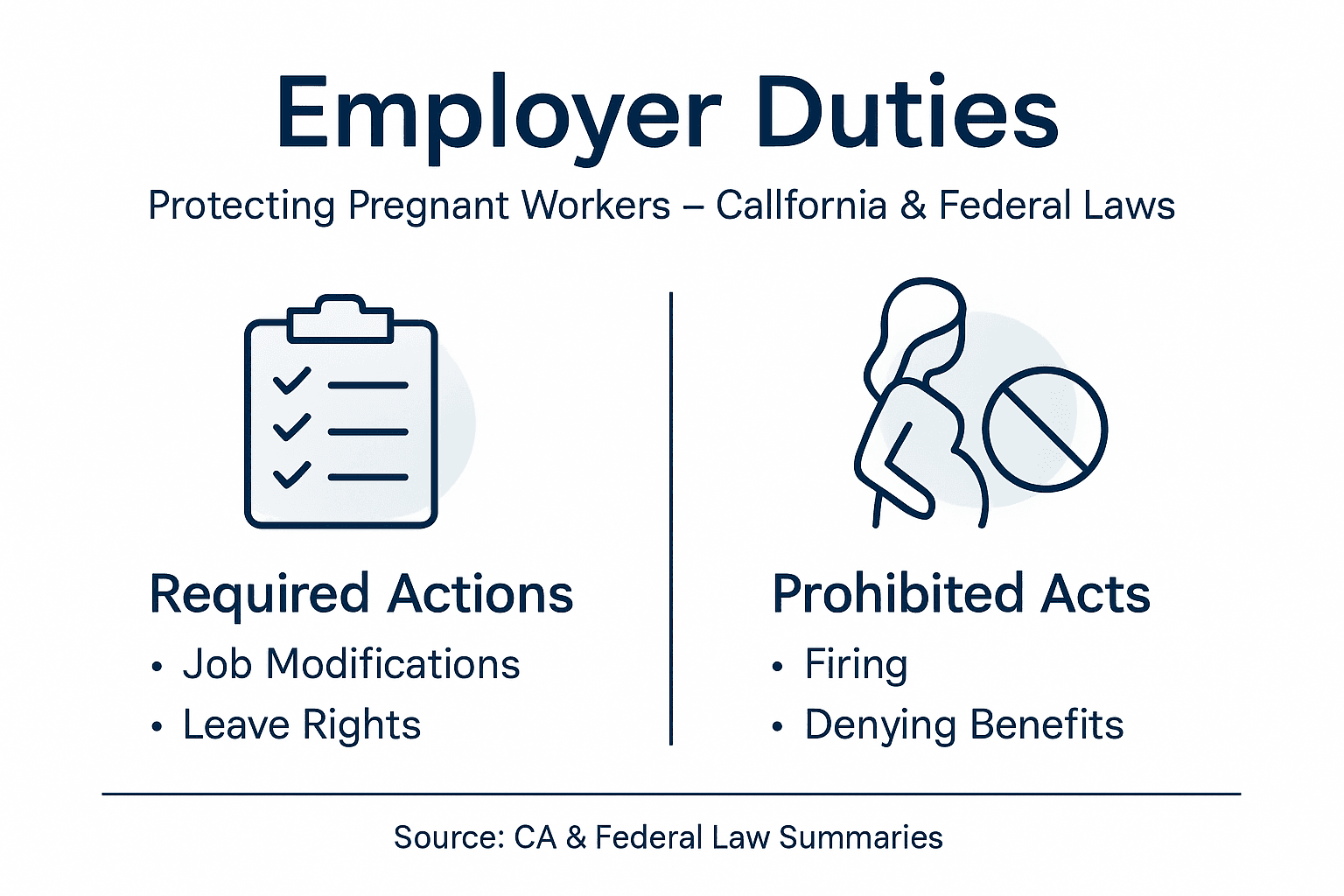
Under federal and state regulations, employers must actively accommodate pregnant workers by modifying job duties, providing alternative assignments, adjusting work schedules, and ensuring seamless reinstatement to equivalent positions after pregnancy disability leave.
This includes providing private spaces for breast milk expression, offering additional break times, and maintaining full compensation and benefit structures. Employers who fail to meet these requirements or retaliate against pregnant employees can face significant legal consequences, including monetary penalties and potential discrimination lawsuits.
Pro tip: Document all workplace interactions and requested accommodations in writing to create a clear record of your employer’s response to your pregnancy-related needs.
Filing Complaints and Pursuing Legal Action
Navigating pregnancy discrimination legal challenges requires a strategic and methodical approach. Filing a discrimination complaint involves carefully documenting evidence and understanding the complex procedural requirements that govern workplace civil rights claims.
The primary pathway for addressing pregnancy discrimination typically begins with filing a formal complaint with the Equal Employment Opportunity Commission (EEOC). Workers must submit their complaint within specific statutory timeframes, usually 180 days from the discriminatory incident.
This initial filing serves as a critical first step, providing an official record of the workplace violation and triggering potential investigative and legal remedies. The complaint should comprehensively detail the discriminatory actions, including specific dates, witnesses, and tangible evidence demonstrating how the employer’s behavior violated pregnancy discrimination protections.
After filing with the EEOC, pregnant employees have several potential legal avenues. These may include administrative hearings, negotiated settlements, or pursuing civil litigation to seek remedies such as reinstatement, back pay, compensatory damages, and mandatory workplace policy changes.
State and federal laws provide robust protections, allowing workers to challenge discriminatory practices through administrative agencies or direct court proceedings. Gathering comprehensive documentation, including performance reviews, communication records, and witness statements, becomes crucial in building a compelling legal case that substantiates claims of pregnancy-related workplace discrimination.
Pro tip: Preserve all communication records and maintain a detailed, contemporaneous log of discriminatory incidents to strengthen your potential legal claim.
The following table summarizes key steps in filing a pregnancy discrimination claim:
| Step | Purpose | Critical Action |
|---|---|---|
| Documentation | Build factual evidence | Log events and witnesses |
| File with EEOC | Officially report discrimination | Submit complaint in 180 days |
| Investigation | Evaluate merits of claim | Cooperate with investigators |
| Legal Remedies | Seek compensation or change | Pursue hearings or lawsuits |
Common Pitfalls and Steps for Stronger Claims
Building a robust pregnancy discrimination claim requires strategic preparation and meticulous attention to legal details. Evidence collection strategies play a critical role in transforming a potential claim into a compelling legal case that can withstand rigorous scrutiny.
One of the most common pitfalls employees encounter is insufficient documentation of discriminatory incidents. Successful claims demand comprehensive evidence demonstrating a clear pattern of differential treatment. This includes preserving email communications, performance reviews, witness statements, and detailed records of workplace interactions that highlight pregnancy-related bias.
Employees must carefully document specific instances where they were treated differently from non-pregnant colleagues, such as being denied promotions, reassigned to less desirable roles, or subjected to harassment.
Navigating the legal landscape requires understanding both procedural requirements and substantive legal protections. Claimants must be mindful of strict filing deadlines, typically 180 days from the discriminatory incident for EEOC complaints, and must precisely articulate how their employer violated pregnancy discrimination laws.
Consulting with an experienced employment attorney can help identify nuanced forms of discrimination that might not be immediately apparent, such as subtle patterns of marginalization or indirect forms of workplace retaliation.
Pro tip: Create a chronological, detailed log of all pregnancy-related workplace interactions, including dates, specific incidents, and potential witnesses, to build a compelling and credible legal narrative.
Protect Your Rights Against Pregnancy Discrimination in Fresno Workplaces
Pregnancy discrimination can deeply affect your career, financial stability, and peace of mind. If your employer has denied reasonable accommodations, reduced your job responsibilities, or treated you unfairly because of your pregnancy, you do not have to face this challenge alone.
Understanding your legal rights is only the first step. You need a trusted partner who knows how to fight for justice and secure the compensation you deserve.
At Goldberg & Loren, our experienced employment law attorneys have over 120 years of combined practice helping workers in Fresno and nationwide overcome workplace discrimination. We are committed to holding employers accountable for unlawful treatment related to pregnancy and ensuring you receive fair treatment, including assistance with filing complaints and pursuing legal action.
Don’t wait to take control of your situation. Learn more about how we can support you by calling (559) 603-8332 for a free pregnancy discrimination consultation.
Frequently Asked Questions
What constitutes pregnancy discrimination in the workplace?
Pregnancy discrimination occurs when an employer treats an employee unfairly due to her pregnancy status, related medical conditions, or future childbearing plans. This could include actions like termination, demotion, or denial of promotions because of the employee’s pregnancy.
What legal protections do pregnant employees have?
Pregnant employees are protected under both federal and state laws from discrimination based on pregnancy, childbirth, or related medical conditions. This includes provisions for reasonable accommodations, pregnancy disability leave, and equal treatment in hiring, promotions, and benefits.
How should I document pregnancy discrimination incidents?
It’s crucial to keep a detailed log of any workplace interactions related to your pregnancy status. Document specific incidents, including dates, witnesses, and any adverse actions taken against you, as this information can be vital in proving your case if you decide to file a complaint.
What steps should I take if I experience pregnancy discrimination?
If you experience pregnancy discrimination, you should document the incidents and file a formal complaint with the Equal Employment Opportunity Commission (EEOC) within the designated time frame, typically 180 days from the discriminatory act. Collect evidence and consider consulting an employment attorney for guidance on pursuing your case.
Recommended
- California Pregnancy Discrimination Lawyer
- California Labor Law Updates
- FMLA & CFRA Violations in California: Employee Rights
- Complete Guide to Discriminatory Termination in California