Fired During Pregnancy in Fresno, CA – Your Rights & Legal Options
Facing job loss or unfair treatment at work because of pregnancy is a reality many women in Fresno encounter. The fear and confusion that come with sudden changes in employment can leave you searching for answers about your rights.
Pregnancy discrimination is unlawful under the Pregnancy Discrimination Act (PDA), meaning you are supported by federal protections if your employer treats you differently due to pregnancy, childbirth, or related medical conditions.
This guide breaks down what counts as discrimination and reveals the legal steps available when you need to fight for fair workplace treatment.
What Qualifies as Pregnancy Discrimination
Pregnancy discrimination occurs when an employer treats you unfavorably because you are pregnant, gave birth, or have a medical condition related to pregnancy or childbirth.
The law protecting you is the Pregnancy Discrimination Act (PDA), which amends Title VII of the Civil Rights Act of 1964 and makes discrimination based on pregnancy unlawful sex discrimination. This applies regardless of whether you’re currently pregnant, were pregnant in the past, or might become pregnant in the future.
The PDA covers discrimination across all employment decisions: hiring, firing, pay, job assignments, promotions, layoffs, training, benefits, and everything in between.
What makes something qualify as pregnancy discrimination? It comes down to how your employer treats you compared to other employees in similar situations.
Discrimination under Title VII includes:
- firing you because of your pregnancy,
- denying you job opportunities,
- subjecting you to harassment,
- or failing to provide reasonable accommodations for your pregnancy-related limitations.
For example, if your employer fires you after you announce your pregnancy but keeps male employees who take medical leave, that’s discrimination. If you request a temporary schedule change due to pregnancy complications and your employer denies it while granting similar accommodations to employees with other medical conditions, that qualifies too.
Your employer cannot force you to take leave, demote you, reduce your pay, or cut your hours simply because you’re pregnant. If an employer treats pregnancy-related conditions differently from other medical conditions, that’s also illegal.
A critical protection under the Pregnant Workers Fairness Act (PWFA) requires your employer to provide reasonable accommodations for pregnancy-related limitations unless doing so would cause undue hardship to the business.
This means accommodations like:
- modified work duties,
- flexible scheduling,
- seating arrangements,
- or temporary leave must be seriously considered.
The burden falls on your employer to show why accommodating your needs would create significant operational or financial difficulty. What makes this protection valuable is that you don’t need to prove your employer acted out of intentional malice.
The pattern of treatment matters more than the motivation. If decisions about your employment changed once your pregnancy became known, that circumstantial evidence can support your claim.
Pro tip: Document everything from the moment you inform your employer about your pregnancy, including conversations about accommodations, performance feedback that differs from pre-pregnancy reviews, and any denials of requests. Keep records of how pregnant colleagues or employees with similar medical conditions were treated compared to you, as this comparative evidence is crucial for proving discrimination.
Essential Laws Protecting Pregnant Workers
You have multiple federal laws working in your favor if you’re pregnant and facing employment challenges in Fresno. The Pregnancy Discrimination Act (PDA) is your foundational protection, prohibiting employers from making adverse employment decisions based on your pregnancy, childbirth, or pregnancy-related medical conditions.
This means your employer cannot fire you, demote you, reduce your pay, deny promotions, or treat you differently in any employment decision simply because you’re pregnant.
The PDA also requires that pregnancy-related conditions be treated the same way as other medical conditions affecting your ability to work. If a coworker with a temporary medical limitation gets accommodations or modified duties, you must receive equal treatment for your pregnancy-related needs.
Beyond the PDA, the Pregnant Workers Fairness Act (PWFA), which became effective on June 27, 2023, provides a stronger layer of protection by requiring your employer to provide reasonable accommodations for pregnancy-related limitations.
This law shifted the landscape significantly because it requires your employer to actively consider accommodations like modified work schedules, temporary leave, seating arrangements, or adjusted duties unless they can prove the accommodation would cause undue hardship to the business. The threshold for “undue hardship” is high, meaning your employer cannot simply claim inconvenience or extra cost.
Additionally, federal protections for pregnant workers extend through the Family and Medical Leave Act (FMLA), which allows you to take unpaid, job-protected leave for pregnancy-related medical needs, childbirth, or bonding with a newborn.
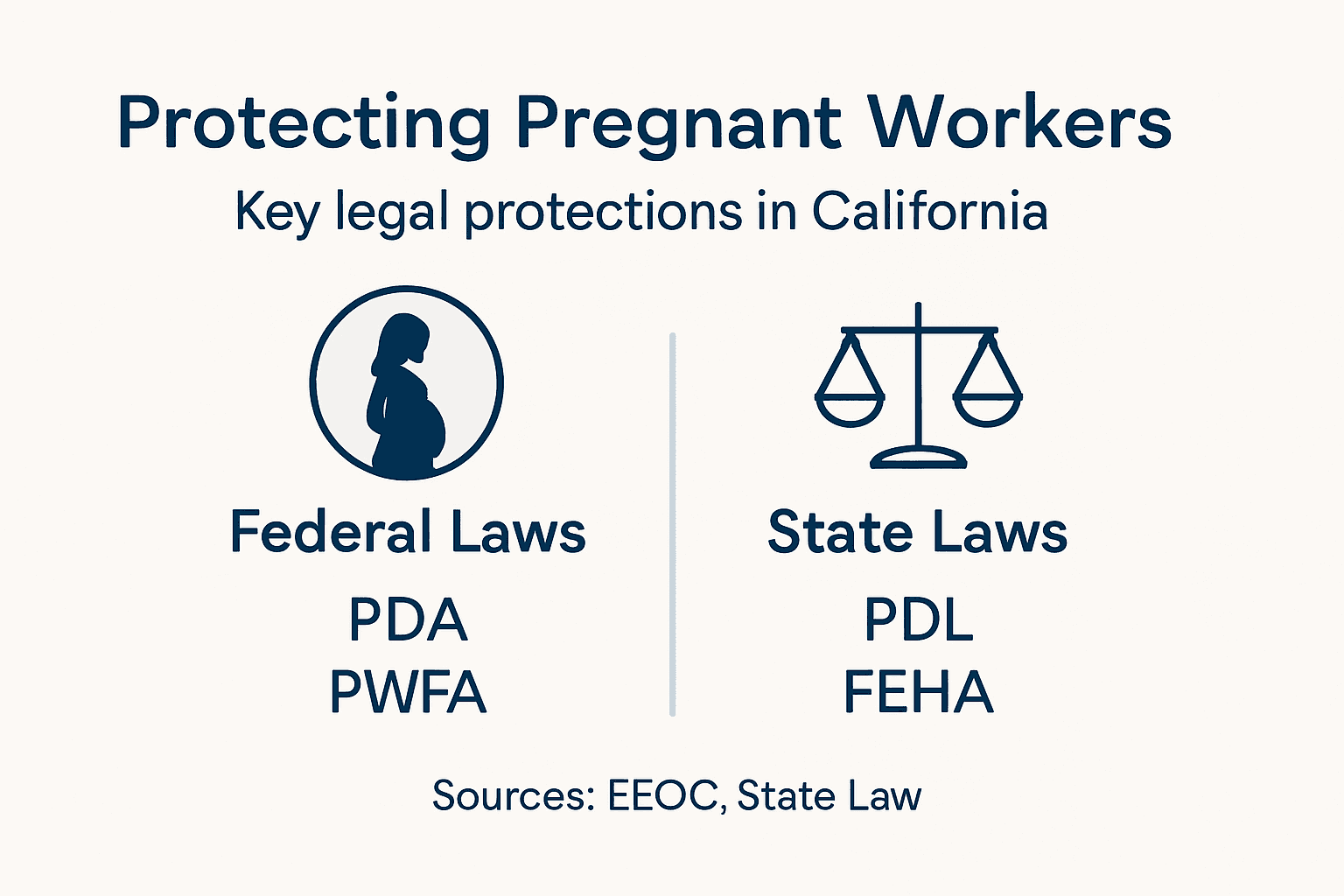
California adds its own protections on top of these federal laws. The state’s Pregnancy Disability Leave (PDL) law provides up to four months of unpaid leave for pregnancy-related disabilities, and employers must maintain your health insurance during this leave.
California also requires employers to provide reasonable accommodations for known physical or mental limitations related to pregnancy, and you cannot be forced to take leave if you are able to work. The state’s Family Rights Act (CFRA) complements FMLA by extending similar protections, sometimes with more generous terms.
Understanding which law applies to your specific situation matters because they sometimes overlap, and you may have rights under multiple statutes. For instance, if your employer violates both the PWFA and California PDL, you could have multiple claims.
Here’s how key laws for pregnancy protection compare:
| Law/Act Name | Main Protection | Who It Covers | Maximum Leave Allotted |
|---|---|---|---|
| Pregnancy Discrimination Act (PDA) | Prohibits discrimination due to pregnancy | All U.S. employees | Not specified (covers actions) |
| Pregnant Workers Fairness Act (PWFA) | Requires reasonable accommodations | Most U.S. employees | Based on need/limitations |
| Family and Medical Leave Act (FMLA) | Job-protected leave for childbirth/adoption | Eligible U.S. employees | Up to 12 weeks unpaid |
| Pregnancy Disability Leave (PDL, CA) | Leave for pregnancy-related disability | California employees | Up to 4 months unpaid |
| California Family Rights Act (CFRA) | Job-protected leave for family needs | California employees | Up to 12 weeks unpaid |
Pro tip: Before filing any complaint, gather documentation showing your employer knew about your pregnancy, any accommodation requests you made in writing or email, and evidence of how your treatment changed after you disclosed your pregnancy compared to how non-pregnant employees with similar medical conditions were treated.
Legal Rights During Leave and Termination
Taking leave for pregnancy-related medical needs should never cost you your job, yet many pregnant workers in Fresno face termination or retaliation after requesting time off. Federal law is clear on this point: your employer cannot fire, demote, or force you to take leave simply because you are pregnant or need time for pregnancy-related medical care.
Under the Family and Medical Leave Act (FMLA), you have the right to take up to 12 weeks of unpaid, job-protected leave in a 12-month period for pregnancy-related medical needs, childbirth, or bonding with a newborn.
This means your employer must hold your job or an equivalent position open while you are on leave, and your health benefits must continue as if you were actively working.
The same protections apply under California’s Pregnancy Disability Leave (PDL) law, which provides up to four months of leave for any period you are unable to work due to pregnancy or childbirth.
What makes termination during or after pregnancy-related leave illegal is that your employer cannot use your leave as an excuse to eliminate your position, reduce your hours, or replace you permanently.
Protected leave rights exist specifically to prevent retaliation for taking time you are legally entitled to. If your employer fires you within a few weeks or months after you return from pregnancy leave, or if they deny you a promotion you were expecting before your leave, those actions raise serious questions about illegal retaliation.
The burden shifts to your employer to prove they had a legitimate, non-discriminatory reason for the termination that had nothing to do with your pregnancy or leave. In practice, this means if your performance reviews suddenly dropped after you announced your pregnancy, or if you were let go during a supposed “restructuring” that coincidentally happened after your maternity leave request, that pattern of events supports a discrimination claim.
You also cannot be forced to take leave if you are able to perform your essential job duties, even if you are pregnant. Your employer cannot push you out the door under the guise of “protecting” you or your pregnancy.
Conversely, if you request reasonable accommodations like flexible scheduling, modified duties, or temporary work-from-home arrangements to manage your pregnancy-related limitations, your employer must provide them unless they can demonstrate undue hardship.
Being pregnant or taking leave does not strip away your basic employment protections. You have the same rights to fair treatment, prompt payment of wages, and workplace safety as any other employee.
If your employer terminated you without valid cause while you were on pregnancy-related leave, or shortly after you returned, that termination is likely unlawful and actionable.
Pro tip: If you are on pregnancy-related leave or considering taking leave, send your employer a written request via email clearly stating the dates of your leave and referencing the specific law protecting your leave rights (FMLA or California PDL), then keep copies of their response and any communications about your return date to establish a clear record of your leave status.
Recognizing Signs of Wrongful Firing
You might suspect your termination was wrongful, but knowing what red flags to look for makes a real difference in building a strong case. Wrongful firing related to pregnancy doesn’t always announce itself clearly.
Sometimes the signs are subtle, buried in the timing, the language your employer used, or the sudden shift in how you were treated. The key is recognizing patterns rather than isolated incidents.
A single negative performance review after years of positive feedback, combined with your pregnancy announcement, raises questions. Being laid off during a “reorganization” that happened to occur right after you requested maternity leave looks suspicious.
Having your job eliminated while your non-pregnant coworkers in similar positions kept theirs sends a message. These patterns matter because they suggest your pregnancy, not legitimate business reasons, motivated the decision.
Watch for sudden changes in how your employer treats you once your pregnancy becomes known. Before your announcement, you might have received glowing performance reviews, regular raises, and positive feedback.
After disclosing your pregnancy, that dynamic shifts. Your manager suddenly documents minor mistakes you made for years without issue. Projects you handled successfully are reassigned to others. You are excluded from meetings or communications you previously attended. You are passed over for opportunities or promotions you seemed qualified for.
Your workload increases dramatically, or conversely, you are given nothing meaningful to do. Bosses make comments about your appearance, your ability to handle stress, or whether you “really” need the job. These behavioral changes create a trail showing your pregnancy triggered the negative treatment.
The timing of termination matters significantly. Understanding wrongful termination helps you recognize when firing is illegal versus justified. If you were fired immediately after announcing your pregnancy, during pregnancy-related leave, or shortly after returning from maternity leave, those timelines raise immediate red flags.
Employers rarely fire someone purely by coincidence within weeks of their pregnancy announcement. If the stated reason for firing does not match what happened in reality, that inconsistency is telling. Your employer says you were let go for poor performance, yet you had no performance improvement plan, no prior warnings, and strong reviews just months earlier.
They claim a restructuring eliminated your position, but your job was filled by someone else or performed by your team. They say you violated a policy, yet that same policy was ignored when other employees violated it. These contradictions between stated reasons and actual facts support a wrongful termination claim.
One more pattern to track: how your employer handled requests for accommodation or disclosure of your pregnancy.
- Did they immediately refuse reasonable requests for flexibility, modified duties, or temporary schedule adjustments?
- Did they react negatively or punitively after you informed them you were pregnant?
- Did they treat you differently than they treated other employees with temporary medical limitations?
- Did they make it clear your pregnancy was unwelcome or inconvenient?
These responses, documented at the time they occurred, create powerful evidence that your employer’s decision to fire you was rooted in pregnancy discrimination rather than legitimate reasons.
Common employer actions and what they may indicate:
| Employer Action | Possible Legal Issue | Pattern Suggestion |
|---|---|---|
| Fired after pregnancy disclosure | Pregnancy discrimination | Timing linked to announcement |
| Denied workplace accommodation | Failure to accommodate | Treated differently than others |
| Terminated post-leave | Retaliation for taking leave | Close timing after return |
| Demoted during pregnancy | Unlawful adverse action | Status changed without justification |
| Passed over for promotion | Discriminatory employment decision | Pattern following pregnancy news |
Pro tip: Create a detailed timeline of key events starting from when you informed your employer of your pregnancy, documenting your job title, responsibilities, performance reviews, any accommodation requests, changes in treatment, and the final termination, then cross reference this timeline with employment records like emails, schedules, and written performance evaluations to identify patterns that show your termination was connected to your pregnancy.
Steps to Take If You’re Fired While Pregnant
Being fired while pregnant feels devastating, but your immediate actions in the hours and days after termination can significantly impact your legal case. The first priority is understanding what just happened.
Request a written explanation of the reason for your termination and ask for your final paycheck including all accrued vacation time or paid time off. In California, your employer must provide your final paycheck by the end of your last working day or within 72 hours, whichever is earlier. Keep this documentation. If your employer gives you a reason verbally, ask them to put it in writing via email.
Do not accept vague explanations like “it’s not working out” without pressing for specifics. The more detailed the written reason, the easier it becomes to challenge inconsistencies later.
Second, gather and preserve all evidence related to your employment and termination. Collect copies of performance reviews, emails, text messages, schedules, and any communications about your pregnancy, accommodation requests, or the termination itself. If you have your personnel file, request a copy immediately.
Take screenshots of your email inbox and any messages from your employer before they disappear. Write down the names and contact information of witnesses who heard conversations about your pregnancy or saw how you were treated. Get their email addresses or phone numbers while you remember them.
Document the date, time, and content of conversations with your manager or HR about your pregnancy. Note when you informed your employer you were pregnant and how they reacted. Write down the exact words used if they made any pregnancy-related comments.
This contemporaneous documentation of events is gold in a pregnancy discrimination case because it shows what happened when it happened, not months later from memory.
Third, file a complaint with the appropriate agencies before time runs out. You have 180 days from the date of termination to file a charge of discrimination with the Equal Employment Opportunity Commission (EEOC) under federal law, though California extends this to one year under state law.
However, do not wait. Filing early protects your rights and triggers an investigation. You can also file a complaint with the California Department of Fair Employment and Housing (DFEH) simultaneously. These agencies investigate at no cost to you.
Your complaint does not require you to have a lawyer at this stage, though having legal representation helps. The complaint should describe what happened, when it happened, who was involved, and why you believe your pregnancy motivated the termination. Be factual and specific.
Finally, consult with an employment attorney who specializes in pregnancy discrimination. You have limited time to protect your rights, and the laws are complex.
An attorney can review your situation, advise you on your legal options, and represent you in negotiations or litigation. Many employment lawyers work on contingency, meaning you pay nothing unless you win.
Your attorney can also send a demand letter to your employer, which often prompts settlement discussions before a formal lawsuit becomes necessary.
Pregnancy discrimination cases require proving your employer knew you were pregnant and that pregnancy was a motivating factor in the termination decision. An experienced lawyer knows how to build that evidence from the facts you provide.
Pro tip: Within 24 hours of termination, send yourself an email documenting everything you remember about your pregnancy, your job performance, your employer’s reactions, and the termination itself, including dates and names, then immediately contact an employment attorney to discuss your situation and preserve evidence before details fade from memory.
Stand Strong If You Were Fired While Pregnant in Fresno
Being fired or treated unfairly because of your pregnancy can feel overwhelming and isolating. If your employer ignored these laws, denied your rights, or retaliated against you for requesting accommodations or leave it is critical to act quickly before time limits expire.
At Goldberg & Loren, we understand the emotional and financial pain that comes with pregnancy discrimination in the workplace. Our experienced team fights to hold employers accountable and win the compensation and justice you deserve.
Don’t wait to protect your rights and secure your future. Take control of your situation now by calling (559) 603-8332 to schedule a free pregnancy discrimination consultation. You’ll pay nothing, unless we win.
Frequently Asked Questions
What is pregnancy discrimination?
Pregnancy discrimination occurs when an employer treats you unfavorably because you are pregnant, gave birth, or have a medical condition related to pregnancy or childbirth. The Pregnancy Discrimination Act (PDA) makes such discrimination unlawful.
What legal protections do I have if I’m fired while pregnant?
If you are fired while pregnant, you may be protected under several laws, including the Pregnancy Discrimination Act (PDA) and the Pregnant Workers Fairness Act (PWFA), which prohibits discrimination and mandates reasonable accommodations for pregnancy-related limitations.
What should I do immediately after being fired while pregnant?
After being fired, request a written explanation for your termination, gather evidence related to your employment, and consider filing a complaint with the Equal Employment Opportunity Commission (EEOC) or the California Department of Fair Employment and Housing (DFEH).
How can I prove wrongful termination due to pregnancy?
You can prove wrongful termination by documenting any changes in treatment after disclosing your pregnancy, collecting evidence of favorable performance reviews prior to termination, and showing how other employees with similar conditions were treated differently.
Recommended
- California Pregnancy Discrimination Lawyer
- Wrongfully Terminated in Bakersfield? Find Your Expert Lawyer Now.
- Complete Guide to Unlawful Job Termination in California
- Wrongful Dismissal in California: Complete Guide