Disability Discrimination in Fresno: Know Your Legal Rights
Getting fair treatment at work should not feel like a daily battle in Fresno. Yet many people with disabilities still face silent exclusion or unfair decisions that block them from jobs, promotions, or equal pay.
Under the Americans with Disabilities Act, disability discrimination is illegal and you have protections that cover every stage of employment.
If you are unsure what your rights mean or need to know how to claim compensation when those rights are violated, practical answers and strong legal support are available.
What Disability Discrimination Means in Fresno
Disability discrimination in Fresno is not always obvious. It does not always come with a memo or a direct statement. Sometimes it happens quietly, through decisions that exclude you from opportunities others receive automatically.
Under the Americans with Disabilities Act (ADA), disability discrimination occurs when individuals with physical or mental impairments that substantially limit major life activities are treated unfairly or denied equal opportunities.
This protection covers people perceived to have disabilities as well, meaning your employer cannot make assumptions about your limitations and use those assumptions against you.
In Fresno, this federal law applies to all aspects of employment, from hiring decisions through termination, compensation, and the daily work environment.
What makes disability discrimination tricky in real workplace situations is that it often operates through multiple layers. Discrimination manifests through both attitudinal and structural barriers that prevent full inclusion and equal opportunity.
Think of attitudinal barriers as the assumptions people make about your capabilities. An employer might assume that because you use a wheelchair, you cannot perform job duties that actually fall well within your abilities. Structural barriers are the physical or policy-based obstacles.
For example, a workplace with no accessible parking, no accessible restrooms, and meetings held only in rooms on upper floors with no elevator access creates structural discrimination regardless of anyone’s intentions.
Other common forms include:
- Refusing to hire qualified candidates because of disability status
- Failing to provide reasonable accommodations that would allow you to perform your job
- Paying lower wages or denying promotions based on disability
- Creating a hostile work environment through harassment or exclusion
- Terminating employment because of disability rather than job performance
- Making assumptions about your abilities and restricting your work accordingly
The law recognizes disability as a protected characteristic the same way it protects against discrimination based on race, color, sex, and national origin. This matters in Fresno because it means you have legal standing to challenge unfair treatment.
If your employer cannot show that your disability genuinely prevents you from performing the essential functions of your job, and they refuse to offer reasonable accommodations that would enable you to perform those functions, their actions likely violate the ADA.
A reasonable accommodation might be flexible scheduling for medical appointments, remote work options, modified equipment, or adjusted break times. It does not have to be perfect or cost nothing. It simply has to be feasible and effective.
One important distinction: discrimination based on disability requires that you actually have a disability or be perceived as having one. You must also be qualified for the position. The law does not require employers to hire unqualified people or to create jobs.
What it does require is that qualified individuals with disabilities receive equal consideration and access to the same opportunities as everyone else. If you can do the job with or without reasonable accommodation, the disability itself cannot be the reason you are excluded.
Pro tip: Document everything that happens regarding your disability and work. Keep records of emails, conversations about accommodations, medical appointments, and any comments made by supervisors or colleagues about your disability. This documentation becomes crucial evidence if you need to pursue a discrimination claim.
Common Types and Workplace Examples
Disability discrimination shows up in countless ways across Fresno workplaces. What makes it complex is that the same action might be discrimination in one context but perfectly legal in another. The key factor is whether the employer is treating you differently because of your disability or perceived disability.
Treating employees differently because of their disability includes actions in hiring, firing, promotions, pay, training, or job assignments. But discrimination also extends beyond just employment decisions.
Harassment due to disability, asking prohibited medical questions, maintaining physical barriers that prevent access, and refusing to provide reasonable accommodations all constitute illegal discrimination under federal law and California regulations.
Let’s look at concrete examples that happen in real Fresno workplaces. An employer learns during the interview process that a candidate uses a cane. The candidate is clearly qualified, but the employer worries about workplace safety and decides not to hire them. That’s discrimination.
Another scenario: an employee becomes deaf after an accident and requests written communication during meetings along with a sign language interpreter. The employer tells them it costs too much and refuses. That’s also discrimination because the employer did not explore whether the accommodation causes undue hardship.
Here are situations you might encounter:
- A manager assumes someone with anxiety disorder cannot handle high-pressure deadlines and removes them from important projects without asking their input
- An employee requests flexible work hours to attend medical appointments related to their disability and is denied while other employees receive flexible schedules
- A company fires an employee shortly after learning about their disability diagnosis, claiming unrelated performance issues
- Workers with disabilities are excluded from training programs or advancement opportunities available to others
- An employer asks detailed medical questions during the hiring process that they would never ask non-disabled candidates
- A workplace lacks accessible parking, elevators, or restrooms, creating barriers that prevent disabled employees from performing their jobs
- An employee is subjected to comments like “You don’t look disabled” or jokes about their condition, creating a hostile environment
California law is particularly protective. Under state regulations, California prohibits discrimination based on disability in employment for employers with five or more employees. This means Fresno employers cannot deny reasonable accommodations, engage in harassment, or treat disabled employees unfairly in hiring, firing, pay, benefits, or other employment terms.
The law places an affirmative duty on employers to prevent harassment and accommodate disabilities unless doing so causes genuine undue hardship. That is a high bar. Simply preferring not to spend money, convenience, or minor disruption does not qualify as undue hardship.

One important point: the employer must engage in a genuine dialogue with you about accommodations. They cannot unilaterally decide what will or will not work. If you need a specific accommodation, communicate it clearly in writing. If they refuse, ask them to explain why it causes undue hardship. Their explanation must be specific and documented. Vague refusals without justification often violate the law. The same applies to hiring.
If you can perform the essential functions of a job with or without reasonable accommodation, the employer cannot exclude you based on disability.
Pro tip: Request accommodations in writing via email so you have a documented record of what you asked for and when. If the employer denies your request, ask them to respond in writing explaining their reasons. This creates a paper trail that protects you if you need to file a complaint or legal claim later.
Key Laws Protecting Disabled Employees
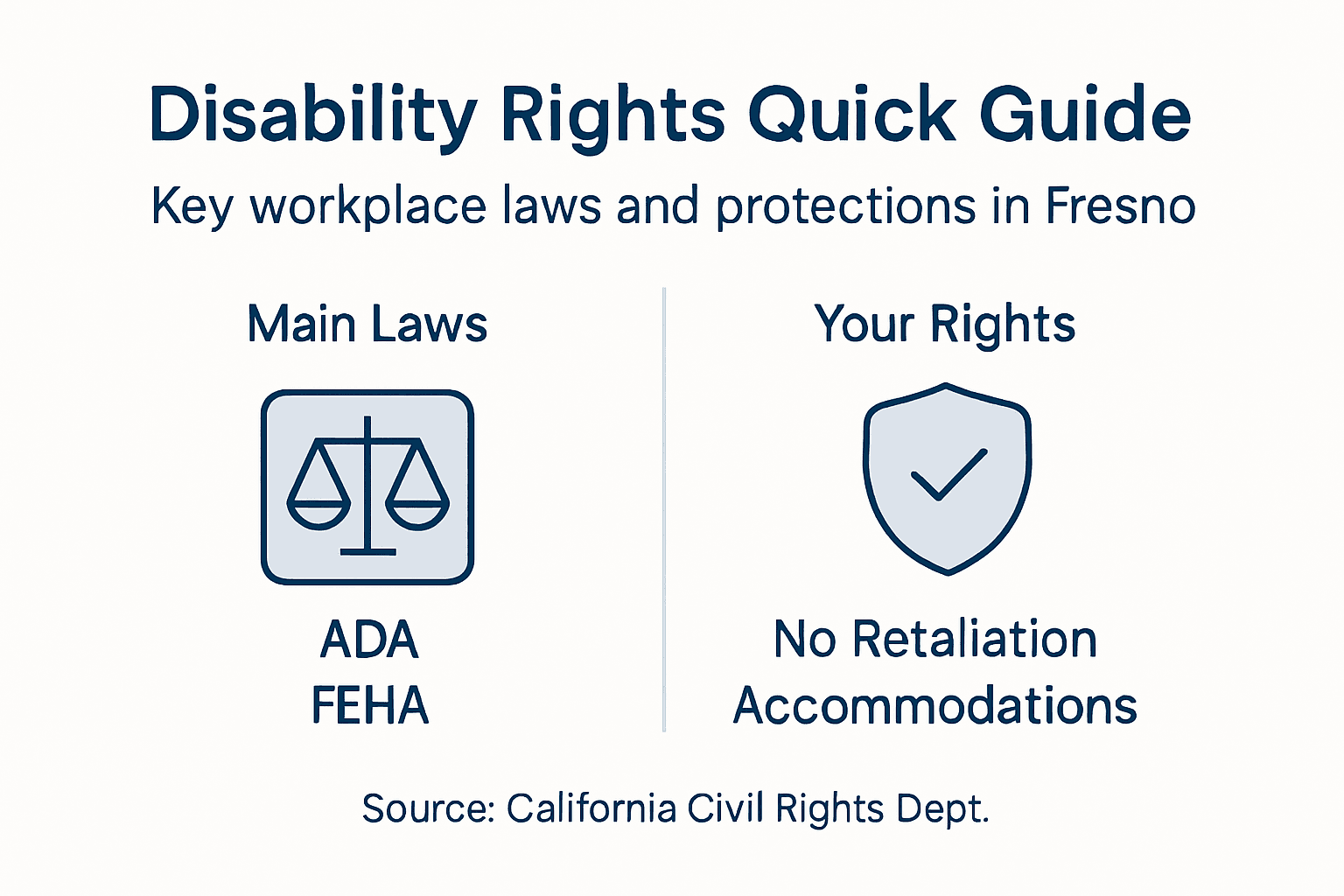
You are not alone in facing disability discrimination in Fresno. Multiple layers of legal protection exist to shield you from unfair treatment. The foundation starts with the Americans with Disabilities Act, the federal law that applies nationwide.
The ADA prohibits discrimination in employment decisions including hiring, firing, pay, training, promotions, and leave. It covers employers with 15 or more employees. But Fresno is in California, and California goes further.
The Fair Employment and Housing Act (FEHA) provides additional protections that many people do not realize. FEHA applies to employers with just five or more employees, meaning smaller companies that fall outside the federal ADA net are still bound by California law. This matters because Fresno has many mid-sized employers that meet California standards but might try to claim they are too small to comply with federal law.
The ADA requires employers to provide reasonable accommodations unless doing so creates undue hardship. This is one of the most misunderstood concepts. Undue hardship does not mean the accommodation costs money or requires effort. It means the accommodation would cause significant difficulty or expense when considered in relation to the employer’s resources and operations.
A large corporation cannot claim undue hardship simply because an accommodation costs several thousand dollars. A small business owner might have legitimate undue hardship concerns, but even then, the employer must explore alternatives. The law also protects you from retaliation if you assert your rights.
If you request an accommodation, file a complaint, or participate in an investigation, your employer cannot punish you by cutting your hours, reducing your pay, or firing you.
California’s FEHA strengthens these protections in several ways. It covers more employers due to the lower five person threshold. It explicitly prohibits harassment based on disability, which the ADA also covers but California clarifies.
FEHA mandates reasonable accommodations and prohibits discrimination in all employment decisions with no exceptions for undue hardship that are as limited as the federal standard. California courts have interpreted FEHA broadly, protecting employees in situations where federal courts might allow employer defenses.
The state also recognizes claims under the California Government Code Section 12965, which allows you to file with the Department of Fair Employment and Housing (DFEH) before pursuing litigation. This administrative process gives you multiple paths to seek relief.
Another critical protection comes through workers’ compensation laws if your disability results from a workplace injury. You do not have to prove your employer intended to discriminate. You simply have to show the injury occurred at work.
Additionally, California’s paid family leave and medical leave laws provide time off for disability related medical care, and employers cannot discriminate against you for taking this leave.
If your disability qualifies you under the Federal Medical Leave Act (FMLA) or California Family Rights Act (CFRA), you have protected leave rights. Employers cannot fire you for taking protected leave or request you forego necessary medical treatment.
One practical point: these laws work best when you understand your rights and communicate clearly. When you need an accommodation, frame it as a request, not a demand.
When an employer refuses, ask for the refusal in writing with their reasoning. When you experience what feels like discrimination, document everything immediately. Dates, times, names, witnesses, and what was said or done create a record that proves invaluable later.
If informal resolution does not work, you can file a complaint with the DFEH (state level) or EEOC (federal level). Both agencies investigate at no cost to you. You do not need to hire a lawyer to file, though having legal guidance strengthens your case.
Here’s a summary comparing major disability discrimination laws relevant to Fresno workplaces:
| Law/Regulation | Who is Covered | Key Protections | Enforcement Agency |
|---|---|---|---|
| Americans with Disabilities Act (ADA) | Employers with 15+ employees | Bans discrimination, requires reasonable accommodation | EEOC |
| Fair Employment and Housing Act (FEHA) | Employers with 5+ employees | Adds broader protections, clarifies harassment rules | CRD (CA agency) |
| Workers’ Compensation | All employees | Covers injuries acquired at work | State WC Board |
| FMLA/CFRA | Large and mid-size employers | Grants protected medical leave for disability-related care | Federal/State |
Pro tip: Keep a separate file documenting any disability related interactions at work, including accommodation requests, employer responses, discriminatory comments, and dates. This documentation becomes your strongest evidence if you need to file a complaint or pursue legal action against your employer.
Reasonable Accommodation and Employer Duties
Reasonable accommodation is the bridge between your disability and your ability to work. It sounds simple, but in practice, employers often misunderstand what this term means or deliberately sidestep their obligations.
Employers must provide reasonable accommodations to qualified employees with disabilities that allow them to perform the essential functions of their job, unless doing so causes genuine undue hardship. This is not optional. It is a legal duty. An accommodation might mean modifying your work schedule, providing assistive technology, adjusting job duties, or making facilities accessible. The key word is reasonable.
The law does not require accommodations that are impossible, extraordinarily expensive, or would fundamentally alter the job itself. But it does require employers to think creatively and work with you to find solutions.
Here is what many Fresno employees do not know: your employer has a duty to engage in what the law calls an interactive process with you. This is not a one-time conversation. It is an ongoing dialogue where you communicate your needs and limitations, and your employer explores options. You might suggest a specific accommodation. Your employer might push back saying it is not feasible and suggest alternatives. You discuss, negotiate, and work toward a solution that actually works.
If your employer refuses to participate in this dialogue, refuses to consider reasonable options, or makes assumptions about what you can or cannot do without asking you, that is a violation.
The employer cannot unilaterally decide what accommodations are or are not necessary. They cannot ignore your requests. They cannot require you to accept an accommodation that does not actually address your needs.
The types of accommodations are wide and varied. Some cost nothing. Others require investment. Here are common examples that employers are expected to provide:
- Modified work schedules or flexible hours to attend medical appointments
- Remote or hybrid work arrangements when the job permits
- Accessible parking, entrances, restrooms, and break rooms
- Assistive technology like screen readers, voice recognition software, or specialized keyboards
- Job restructuring where non essential tasks are reassigned
- Written communication instead of or in addition to verbal instructions
- Additional breaks for medications or medical conditions
- Leave for medical treatment or disability management
- Job coaching or training modifications
- Service animals in the workplace
What counts as undue hardship is much more narrow than employers claim. Undue hardship means the accommodation would cause significant difficulty or substantial cost when considered against the employer’s overall resources, operations, and financial situation.
A large corporation with millions in revenue cannot claim hardship because an accommodation costs five thousand dollars. A small business with limited resources might have legitimate concerns, but they still must explore alternatives and compromise. Cost alone is not undue hardship. Inconvenience is not undue hardship.
The accommodation must actually threaten the viability of the business or create impossible operational challenges. If your employer tells you an accommodation is too expensive, ask them for documentation. Ask them to explain specifically how it would harm the business. Vague refusals without real justification often violate the law.
Your employer also has a duty to protect you from retaliation. This means they cannot punish you for requesting an accommodation, for filing a complaint about discrimination, or for participating in an investigation.
Retaliation can look like reduced hours, lower pay, exclusion from opportunities, negative performance reviews, or termination. If any negative employment action happens shortly after you assert your rights, that timing creates legal suspicion. Courts view such coincidences skeptically. An employer cannot fire you, demote you, or cut your pay because you asked for reasonable accommodation. That would violate the law.
Document every accommodation request you make, every response your employer provides, and every employment action that follows. This documentation protects you if you need to file a complaint.
Pro tip: Make your accommodation request in writing and specify exactly what you need and why it would help you perform your job. Include how the accommodation addresses a limitation caused by your disability. When your employer responds, get their response in writing too. If they deny the request, ask them to explain in writing why it causes undue hardship. This creates a clear record of compliance or violation.
How to Take Legal Action in Fresno
Taking legal action against disability discrimination feels overwhelming. You are working, managing your health, and now you have to navigate the legal system. But you do not have to do it alone, and the process is more straightforward than you might think.
Your first step is to file a complaint with a government agency. You have two options that work simultaneously. You can file with the California Civil Rights Department (CRD), which enforces state laws prohibiting workplace discrimination.
You can also file with the federal Equal Employment Opportunity Commission (EEOC). The good news is these agencies often share information, so filing with one does not prevent you from filing with the other.
Filing complaints with the California Civil Rights Department allows the state to investigate your claim, mediate disputes between you and your employer, and potentially take legal action on your behalf. The EEOC does the same at the federal level. Both agencies investigate at no cost to you. You do not need a lawyer to file, though having one strengthens your case significantly.
Here is the timeline and process. When you file a complaint with the CRD or EEOC, the agency assigns an investigator to your case. They contact your employer and request documents related to your employment, your accommodation requests, performance reviews, and any communications about your disability.
The investigator may interview you, your employer, and witnesses. This investigation typically takes several months. The agency then issues a determination. If they find reasonable cause to believe discrimination occurred, they may offer mediation where both sides try to reach a settlement.
If mediation fails or the agency finds no reasonable cause, they issue a right to sue letter. This letter allows you to file a lawsuit in court. You then have a limited time to file suit, so acting quickly matters. Some cases settle during investigation or mediation. Others proceed to litigation.
The timeline from filing to resolution can range from one year to several years depending on complexity and whether the case settles or goes to trial.
What should your complaint include? Be specific and factual. Describe what happened, when it happened, who was involved, and how it harmed you. Include your accommodation request and the employer’s response. Include dates of discriminatory comments or actions. Describe how your disability limited you and why the accommodation you requested was necessary and reasonable.
Attach copies of relevant emails, messages, performance reviews, and other documentation. The more detailed and documented your complaint, the stronger your case. Vague complaints that lack dates and specifics are harder for investigators to pursue.
Remember that Disability Rights California provides legal advocacy and support for people with disabilities facing discrimination. They offer legal representation, can help you understand your rights, and can assist in pursuing legal action to enforce anti-discrimination laws. Contact them if you need guidance on the complaint process.
Beyond government agencies, you have the option to hire an employment lawyer who specializes in disability discrimination. A lawyer can represent you throughout the investigation and litigation process. They can negotiate settlements, file lawsuits, and argue your case in court.
Many employment lawyers work on contingency, meaning they take a percentage of any settlement or verdict you win rather than charging hourly fees upfront. This makes legal representation accessible even if you cannot afford to pay thousands of dollars out of pocket.
A lawyer also handles all the procedural requirements, deadlines, and court filings. They know what evidence matters, how to present your case effectively, and how to value your claim for settlement purposes.
If your case involves significant lost wages, emotional distress, or involves a large employer with resources to fight hard, having legal representation becomes even more important.
Here’s how the complaint and legal action process typically unfolds for disability discrimination cases:
| Step in Process | What Happens | Typical Timeframe | Outcome Possibilities |
|---|---|---|---|
| File Complaint | Submit details to CRD or EEOC | Weeks to months | Case assigned to investigator |
| Agency Investigation | Employer documents reviewed, interviews held | Several months to a year | Mediation offered or right-to-sue letter issued |
| Mediation/Litigation | Attempt settlement or file lawsuit | 1-3 years | Settlement, trial, or dismissal |
| Compensation Award | Damages calculated and awarded | Varies | Back pay, emotional distress, attorney’s fees |
Your compensation can include several categories of damages. Back pay covers wages you lost from the date of discrimination until settlement or trial.
Front pay covers future lost wages if you cannot return to your job. Compensatory damages cover emotional distress, humiliation, and harm to your reputation caused by the discrimination. Punitive damages may be available if the employer’s conduct was particularly egregious or intentional.
The employer must also cover your attorney’s fees and costs if you win. The amount of compensation varies widely based on the severity of discrimination, your lost earnings, how much the experience affected you emotionally, and how sympathetic your case appears to a judge or jury.
Some cases settle for tens of thousands of dollars. Others settle for hundreds of thousands. The strongest cases involve clear documentation of discrimination, significant financial loss, and long-term impacts on your career and health.
Pro tip: File your complaint with both the CRD and EEOC as soon as possible after the discrimination occurs. There are time limits, usually 180 to 365 days depending on which agency, so do not delay. Include every piece of documentation you have. The more specific facts and evidence in your complaint, the easier it is for investigators to pursue your case and find merit in your claims.
Stand Strong Against Disability Discrimination in Fresno
Facing disability discrimination at work can feel isolating and overwhelming. Challenges like refusal of reasonable accommodations, wrongful termination, or hostile work environments threaten not only your livelihood but your dignity.
If you experience discrimination or retaliation related to your disability in Fresno, do not wait to protect your future. At Goldberg & Loren, we specialize in fighting for employees just like you to secure the compensation and justice you deserve.
Our experienced team understands the complexities of disability discrimination claims and provides dedicated support through every stage—from gathering evidence to filing complaints with the CRD or EEOC and pursuing legal action if necessary.
Call (559) 603-8332 for a free disability discrimination consultation to learn how we can guide you through this difficult process with a no-win, no-fee promise. Take control of your rights today and get the strong legal advocacy you need to protect your career and well-being.
Frequently Asked Questions
What constitutes disability discrimination in the workplace?
Disability discrimination occurs when an employer treats an individual unfairly due to their physical or mental impairments that limit major life activities. This includes unfair treatment in hiring, promotions, pay, and job assignments, as well as failing to provide reasonable accommodations.
What are reasonable accommodations?
Reasonable accommodations are modifications or adjustments that enable a qualified employee with a disability to perform the essential functions of their job. Examples include flexible work hours, assistive technology, or modifying job duties to better suit the individual’s needs.
How can I file a complaint about disability discrimination?
You can file a complaint with the California Civil Rights Department (CRD) or the Equal Employment Opportunity Commission (EEOC). Both agencies investigate claims of discrimination at no cost to you and can assist you in resolving your issue.
What protections do I have under the law regarding disability discrimination?
Employees are protected under several laws including the Americans with Disabilities Act (ADA) and the Fair Employment and Housing Act (FEHA). These laws prohibit discrimination based on disabilities and require employers to provide reasonable accommodations unless it poses an undue hardship for the business.